11/11/2006 12:00:00 AM | Athletics
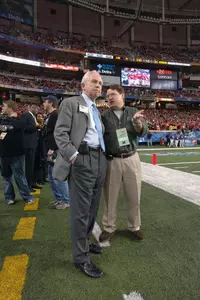
Mike Slive '62 — In Commission
By Jack DeGange
During a recent radio interview, Mike Slive '62 was asked how he manages his time. His answer:
“I spend 100 percent of my time on the SEC, 50 percent on the BCS, and 50 percent on the (NCAA) Men's Basketball Tournament Committee. I'm not sure if the guy understood the math.”
Math aside, this is easy to understand: These days Slive wears several very large hats and ranks among the most influential leaders at the highest level of college sports. Some would suggest he's the most influential.
In 2002, this attorney by trade who frequently uses the borrowed line, “I'm a recovering lawyer,” was named the commissioner of the Southeastern Conference. His contract recently was renewed through 2009, by which time he'll be closing in on his 70th birthday and may think about retiring. Maybe.
Since 2004, he's been a member of the Men's Basketball Tournament Committee. Last spring he began a two-year term as coordinator of the Bowl Championship Series, the mega-pot of gold that will lead to a national championship game in early January.
Slive has been a cerebral bundle of energy since he played lacrosse at Dartmouth more than 40 years ago. He thought about teaching and coaching, maybe becoming a lawyer, or even being a doctor (“until I took chemistry”).
He completed law degree studies at Virginia and Georgetown and a career that would blend the law and athletics began in 1968 as the assistant director of athletics at Dartmouth.
A year later he launched a decade in the New Hampshire legal community: a partner at Stebbins & Bradley in Hanover, judge of the Hanover District Court, and judicial master and clerk of the Grafton County Superior Court.
In 1979, Slive moved to the West Coast as assistant executive director of the Pacific-10 Conference. His principal duty: to be the in-house dispenser of justice in a conference where several member institutions were mired in a maelstrom of NCAA infractions. It was an environment not dissimilar to the situation facing the SEC when he arrived in Birmingham, Ala., four years ago.
From 1981-83, Slive returned to the Ivy League as director of athletics at Cornell, then opened his own law practice in Hanover, a step toward moves that, from 1986-91, saw him become a partner in a Chicago law firm and then a founding partner of Slive-Glazier Sports Group in Chicago and Kansas City.
His knowledge of the law and sports, as a counsel to institutions coping with NCAA violations and athletes aspiring to play professionally, not to mention his familiarity with the geography, made him a natural choice in 1991 to become the first commissioner of the Great Midwest Conference that, in 1995, evolved into Conference-USA.
Those are the steppingstones that brought Slive to the SEC. When he arrived, the conference that includes 12 of the nation's largest and most prestigious institutions had five members that were either on NCAA probation, under NCAA investigation, or conducting an internal review into football violations. His first move: create a conference task force to look at rules issues and “create an atmosphere (where) violations are unacceptable.”
Under Slive, that “unacceptable atmosphere” has been addressed and corrected. Slive points to these statistics for 2005-06 that position the SEC as the nation's strongest athletic conference: In 10 of 20 sponsored sports, the SEC had either the national champion or the national runner-up. It produced 71 individual national champions and 460 first team All-Americans. Two-thirds of all league teams (159) participated in post-season play.
“Leading this program is much larger than simply deciding who plays when and where,” said Slive. “My years at Dartmouth and Cornell, in the Pac-10, the Great Midwest and Conference-USA expanded my view of intercollegiate athletics and higher education.
“I have a higher appreciation for the mission of these (SEC) institutions and the success they've had, on both the educational and athletic sides. In higher education there's a place for everyone: the Ivy League colleges and our member institutions. We have the large state institutions that represent entire states. They become the flag bearers.
“Especially here in the SEC,” Slive continued, “intercollegiate athletics is important because (sports) has a cultural, historical and philosophical place in this area of the country. But, whether it's the SEC or the BCS, you can never lose sight of the fact that intercollegiate athletic competition is still part of higher education.”
That mission has led the SEC to form an Academic Consortium to link the academic resources of the 12 member institutions. There's the business side of the coin as well that reflects the cultural mindset in the world of the SEC: In 2005, 5.6 million people filled SEC football stadiums to 97 percent of capacity.
While football is king, Slive looks beyond. “Basketball (Florida is the defending men's national champion, Tennessee and LSU are perennials on the women's side) has great attendance,” he said. “We had 1.6 million fans at SEC baseball games in 2006. We can draw 10,000 for a gymnastics championship.”
Under the conference's revenue sharing plan, in 2005-06 the SEC distributed a record $116.1 million back to its members. “It's not just about the production of revenue,” said Slive, “but how these funds are used to support the broad base programs for men and women. We have about 5,000 student-athletes, most of them on scholarship. Look at the record: The SEC is the strongest conference in the country. This league has had great success (for nearly 75 years). I want to make it better than it already was.
“American culture adopted intercollegiate athletics as something important (many years ago). Competition has value but it's not to be funded through an institution's general funds. That's why they started selling tickets.
“We're committed to competition at the highest level and to the educational side. The bottom line is to keep things in balance. That's the genius of what we do: keep the balance.”
Slive describes it as part of “the great experiment” that has been part of American culture for more than a century. “In Europe, the focus is on town teams and clubs,” he said. “Here, sports are part of higher education.”
 All of this involves long days and a lot of help for Slive who usually spends three-four days each week on the road to deal with his conference, BCS and basketball tournament responsibilities.
“We depend on our Blackberrys,” said Charles Bloom, the SEC's associate commissioner for more than a decade. “The Commish and I will trade emails before 6 a.m. on most weekday mornings and we're usually in the office by 6:30.
“I tell people that he's the greatest combination of empathy and intelligence that I've ever come across. He cares about his people.”
In coming weeks, Slive's attention will be on the SEC football championship, then the run-up in the still-being-perfected Bowl Championship Series. As Slive said when he succeeded Big 12 Conference Commissioner Kevin Weiberg as BCS coordinator, “We owe it to ourselves over the next couple of years to see if we can reduce the nervousness (over the BCS format), so long as it's consistent with the academic mission of higher education, (to create) a process to determine a national champion.”
Next March, Slive will head to the Georgia Dome in Atlanta. It will be a special event for Mike and his wife, Liz. Their daughter, Anna, with a masters degree in sports administration from the University of Massachusetts, is executive director of the Atlanta Local Organizing Committee for the Men's Final Four.
When the NCAA men's basketball committee (chaired by Gary Walters, the Princeton athletic director) convenes in Atlanta, Slive won't be there as commissioner of the Southeastern Conference.
The Commish said, “When they go around the table for introductions, I'll just say, 'Mike Slive…father.'”
Jack DeGange is a freelance writer and former sports information director at Dartmouth.
By Jack DeGange
During a recent radio interview, Mike Slive '62 was asked how he manages his time. His answer:
“I spend 100 percent of my time on the SEC, 50 percent on the BCS, and 50 percent on the (NCAA) Men's Basketball Tournament Committee. I'm not sure if the guy understood the math.”
Math aside, this is easy to understand: These days Slive wears several very large hats and ranks among the most influential leaders at the highest level of college sports. Some would suggest he's the most influential.
In 2002, this attorney by trade who frequently uses the borrowed line, “I'm a recovering lawyer,” was named the commissioner of the Southeastern Conference. His contract recently was renewed through 2009, by which time he'll be closing in on his 70th birthday and may think about retiring. Maybe.
Since 2004, he's been a member of the Men's Basketball Tournament Committee. Last spring he began a two-year term as coordinator of the Bowl Championship Series, the mega-pot of gold that will lead to a national championship game in early January.
Slive has been a cerebral bundle of energy since he played lacrosse at Dartmouth more than 40 years ago. He thought about teaching and coaching, maybe becoming a lawyer, or even being a doctor (“until I took chemistry”).
He completed law degree studies at Virginia and Georgetown and a career that would blend the law and athletics began in 1968 as the assistant director of athletics at Dartmouth.
A year later he launched a decade in the New Hampshire legal community: a partner at Stebbins & Bradley in Hanover, judge of the Hanover District Court, and judicial master and clerk of the Grafton County Superior Court.
In 1979, Slive moved to the West Coast as assistant executive director of the Pacific-10 Conference. His principal duty: to be the in-house dispenser of justice in a conference where several member institutions were mired in a maelstrom of NCAA infractions. It was an environment not dissimilar to the situation facing the SEC when he arrived in Birmingham, Ala., four years ago.
From 1981-83, Slive returned to the Ivy League as director of athletics at Cornell, then opened his own law practice in Hanover, a step toward moves that, from 1986-91, saw him become a partner in a Chicago law firm and then a founding partner of Slive-Glazier Sports Group in Chicago and Kansas City.
His knowledge of the law and sports, as a counsel to institutions coping with NCAA violations and athletes aspiring to play professionally, not to mention his familiarity with the geography, made him a natural choice in 1991 to become the first commissioner of the Great Midwest Conference that, in 1995, evolved into Conference-USA.
Those are the steppingstones that brought Slive to the SEC. When he arrived, the conference that includes 12 of the nation's largest and most prestigious institutions had five members that were either on NCAA probation, under NCAA investigation, or conducting an internal review into football violations. His first move: create a conference task force to look at rules issues and “create an atmosphere (where) violations are unacceptable.”
Under Slive, that “unacceptable atmosphere” has been addressed and corrected. Slive points to these statistics for 2005-06 that position the SEC as the nation's strongest athletic conference: In 10 of 20 sponsored sports, the SEC had either the national champion or the national runner-up. It produced 71 individual national champions and 460 first team All-Americans. Two-thirds of all league teams (159) participated in post-season play.
“Leading this program is much larger than simply deciding who plays when and where,” said Slive. “My years at Dartmouth and Cornell, in the Pac-10, the Great Midwest and Conference-USA expanded my view of intercollegiate athletics and higher education.
“I have a higher appreciation for the mission of these (SEC) institutions and the success they've had, on both the educational and athletic sides. In higher education there's a place for everyone: the Ivy League colleges and our member institutions. We have the large state institutions that represent entire states. They become the flag bearers.
“Especially here in the SEC,” Slive continued, “intercollegiate athletics is important because (sports) has a cultural, historical and philosophical place in this area of the country. But, whether it's the SEC or the BCS, you can never lose sight of the fact that intercollegiate athletic competition is still part of higher education.”
That mission has led the SEC to form an Academic Consortium to link the academic resources of the 12 member institutions. There's the business side of the coin as well that reflects the cultural mindset in the world of the SEC: In 2005, 5.6 million people filled SEC football stadiums to 97 percent of capacity.
While football is king, Slive looks beyond. “Basketball (Florida is the defending men's national champion, Tennessee and LSU are perennials on the women's side) has great attendance,” he said. “We had 1.6 million fans at SEC baseball games in 2006. We can draw 10,000 for a gymnastics championship.”
Under the conference's revenue sharing plan, in 2005-06 the SEC distributed a record $116.1 million back to its members. “It's not just about the production of revenue,” said Slive, “but how these funds are used to support the broad base programs for men and women. We have about 5,000 student-athletes, most of them on scholarship. Look at the record: The SEC is the strongest conference in the country. This league has had great success (for nearly 75 years). I want to make it better than it already was.
“American culture adopted intercollegiate athletics as something important (many years ago). Competition has value but it's not to be funded through an institution's general funds. That's why they started selling tickets.
“We're committed to competition at the highest level and to the educational side. The bottom line is to keep things in balance. That's the genius of what we do: keep the balance.”
Slive describes it as part of “the great experiment” that has been part of American culture for more than a century. “In Europe, the focus is on town teams and clubs,” he said. “Here, sports are part of higher education.”
All of this involves long days and a lot of help for Slive who usually spends three-four days each week on the road to deal with his conference, BCS and basketball tournament responsibilities. “We depend on our Blackberrys,” said Charles Bloom, the SEC's associate commissioner for more than a decade. “The Commish and I will trade emails before 6 a.m. on most weekday mornings and we're usually in the office by 6:30.
“I tell people that he's the greatest combination of empathy and intelligence that I've ever come across. He cares about his people.”
In coming weeks, Slive's attention will be on the SEC football championship, then the run-up in the still-being-perfected Bowl Championship Series. As Slive said when he succeeded Big 12 Conference Commissioner Kevin Weiberg as BCS coordinator, “We owe it to ourselves over the next couple of years to see if we can reduce the nervousness (over the BCS format), so long as it's consistent with the academic mission of higher education, (to create) a process to determine a national champion.”
Next March, Slive will head to the Georgia Dome in Atlanta. It will be a special event for Mike and his wife, Liz. Their daughter, Anna, with a masters degree in sports administration from the University of Massachusetts, is executive director of the Atlanta Local Organizing Committee for the Men's Final Four.
When the NCAA men's basketball committee (chaired by Gary Walters, the Princeton athletic director) convenes in Atlanta, Slive won't be there as commissioner of the Southeastern Conference.
The Commish said, “When they go around the table for introductions, I'll just say, 'Mike Slive…father.'”
Jack DeGange is a freelance writer and former sports information director at Dartmouth.
Friday, October 23
Friday, October 23
Friday, October 23
Sunday, October 18