A Standard of Excellence
9/27/2007 12:00:00 AM | Football, Athletics
A Standard of Excellence
By Jack DeGange
Winning the Ivy League football championship in any season is hard work. Defending a title successfully is harder still. That's why Dartmouth's streak that reached five in a row, from 1969 to 1973, remains unparalleled in a half-century of Ivy League football.
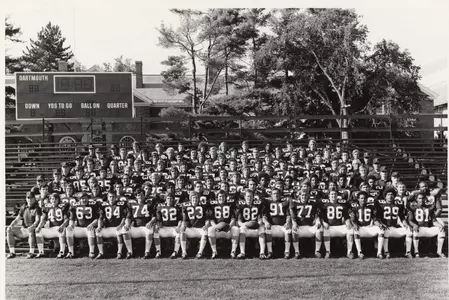
This is the story of the 1972 team that, with a 7-1-1 record, won Dartmouth's fourth straight Ivy championship during a half-decade of success. As each season evolved, new achievement was nourished by the success of preceding seasons.
Among 855 members of the Class of 1973 who arrived in Hanover in the fall of 1969 were 96 players on a freshman football team that would run the table (7-0-0) while the varsity (8-1-0) was igniting the championship fires.
When the 1972 season ended, the '73s who contributed to three more Ivy titles had, as a class, a three-year varsity won-lost record of 24-2-1.
As sophomores, they began to make themselves known on the undefeated 1970 team that won the Ivy title and the Lambert Trophy as the East's outstanding team and was ranked 14th in the nation. Defensive end Fred Radke became a starter. Tight end Gregg Brown, wide receiver Tyrone Byrd and guard Bob Norton were contributors on offense. On defense, tackle Josh Holloway, linebackers Doug Jaeger and Bob Bialas and cornerbacks Weymoth Crowell and Vence Lewis were in the two-deep.
In 1971, when Jake Crouthamel succeeded Bob Blackman as head coach, Dartmouth was 8-1-0 and shared the Ivy title with Cornell. The 73s, now juniors, dotted the starting lineup: Brown and Byrd as receivers, Norton and tackle Dan Bierwagen in the offensive line. Holloway and Tom Tarazevits became starters as defensive tackles. Jaeger, Bialas and Bob Soltess were starting linebackers while Crowell moved up at cornerback. While he didn't become a starter until his senior year, halfback Chuck Thomas was steadily making his mark as a runner and receiver.
The class kicker, Ted Perry, had decisive field goals in wins over Brown, Harvard and Yale, none more memorable than his 46-yarder at Harvard as time expired (set up by Wesley Pugh's 31-yard interception return), giving Dartmouth a 16-13 win.
Also breaking into the lineup late in the season: quarterback Steve Stetson. In the showdown with Cornell at Memorial Field, before a crowd of 20,819 and an ABC-TV regional audience, Stetson ran for a touchdown and passed to Byrd for another. Dartmouth won, 24-14, and Stetson was ABC's player-of-the-game, recognition that seemed destined for Ed Marinaro, Cornell's All-America tailback and Heisman Trophy candidate.
In 1972, Yale and Penn were expected to break Dartmouth's hold on the Ivy trophy even though the Green had an experienced team built around seniors and an offense that featured juniors Rick Klupchak and Ellis Rowe at halfback and fullback and another junior, defensive end Tom Csatari, en route to becoming Dartmouth's first three-time selection to the All-Ivy first team.
When the dust of the 1972 season settled, Dartmouth was on top ? again. “A great deal of credit must go to a super senior group,” said Crouthamel. “Led by (co-captains) Bob Norton and Fred Radke, they compiled a four-year record of 31-2-1 in freshman and varsity games.”
In addition to Radke, Norton, Brown, Byrd, Stetson and others who had starting experience in 1970 and 1971, the offense starters now included Jim (Paco) Johnston and Don Nelson at tackle, Thomas and fullback Steve Webster in the backfield. Defensively, end Kevin O'Shea, linebacker John Leibert, cornerback Dale Pope and safety Wesley Pugh had joined Jaeger, Tarazevits, Bialas and Crowell.
Depth was invaluable. Over the course of the season nearly a dozen players were lost to injury for at least two games including Bierwagen, the tackle, for seven, and senior split end Sam Watkins for six.
Looking back, Crouthamel said, “Character, heart, determination, pride, poise, the will to win. Pick any or all of these terms and you've described the qualities that made the 1972 team Ivy League champions for an unprecedented fourth consecutive year.”
The non-Ivy opponents were grudging victims. A win over New Hampshire, 24-14, was decided by Dartmouth's 10 unanswered points in the fourth period. At Holy Cross, a Stetson-Klupchak 38-yard pass set up Stetson's short TD run burst and Thomas broke a 78-yarder for the clincher in a 17-7 win.
The Ivy League season began with a 35-14 romp over Princeton. Dartmouth's versatile offense netted 447 yards. Halfback Doug Lind's 40-yard option pass to Klupchak got the Green going and Stetson ran for two TDs.
Brown came to Memorial Field and had a 6-0 lead after one period. By halftime, Dartmouth had exploded for 35 points including three scoring passes by Stetson and Ron Smith's 72-yard interception return. The final score: 49-20.
Then came two weeks that would test Dartmouth's character. At Harvard, the Crimson turned two Green fumbles into easy touchdowns. Stetson hit Byrd and Lind with TD passes of 59 and 14 yards. While Perry kicked three field goals he also missed two extra points. The game ended in a frustrating 21-21 tie.
Before 41,500 fans at Yale Bowl, the Elis could do no wrong. Led by All-America halfback Dick Jauron, Yale scored the first four times it had the ball and fumbles blunted hopes for a Green comeback. Yale rolled, 45-14. For Dartmouth, it was gut check time.
“We were bitter after tying Harvard and taking the beating from Yale,” said Byrd. “Those two games humbled us, deepened our pride and made us more determined.”
In 1971, Columbia had ended Dartmouth's 15-game win streak with a 31-29 win in New York. At Hanover in 1972, the Green rolled past the Lions, 38-8 as Stetson completed 16 of 24 passes for 186 yards and the defense forced five turnovers.
The Dartmouth-Cornell game at Ithaca was Ivy football at its best. Three times in the second half, Cornell moved inside Dartmouth's 10-yard line but scored only once. After the last goal-line stand, Dartmouth was clinging to a 24-22 lead, thanks to a Perry field goal, two Stetson-Byrd scoring passes and Stetson's three-yard run.
With the Green simply trying to run out the clock and escape, Klupchak bolted over right tackle and romped 72 yards to clinch a 31-22 victory.
Dartmouth needed a win at Penn to keep the Ivy title. Things didn't start well. “Our bus driver took the wrong exit on the Pennsylvania Turnpike,” said Crouthamel. “We (two buses) had to cross the median and we had to pay a hefty penalty toll. We arrived at Franklin Field a half-hour before kickoff. We had no calisthenics, no pre-game warmup.”
Things only got worse as Penn jumped to a 14-0 lead. Then, the Green awakened: Pugh's 57-yard punt return set up Stetson's score and a Stetson-Klupchak pass made it 14-14 at halftime. It was 17-17 early in the final period when Dartmouth drove 80 yards with Webster covering the final yard.
Klupchak, still uncertain about clock management, iced the title with a 50-yard scoring run to cap the 31-17 win, clinching the crown with a 5-1-1 Ivy record.
Plenty of honors followed ? Bob Norton was named first team All-Ivy and All-East and honorable mention All-America. Also on the All-Ivy first team: Stetson, Klupchak, Brown, center Bob Funk plus Csatari, Tarazevits and Pugh on defense. Second team or honorable mention All-Ivy selection went to Perry, Jaeger, Byrd, Bialas and Crowell.
“The 1972 team may not have been the best in Dartmouth history,” said Crouthamel, “but there was surely no other team with a greater will to win.”
The fourth straight Ivy title was unprecedented ? for a year. In 1973, Dartmouth would make it an unmatched five in a row.
Jack DeGange, a freelance writer, was Dartmouth's sports information director from 1968-77.