1958: A Look at Dartmouth's First Ivy Championship
9/30/2008 12:00:00 AM | Football, Athletics
By Jack DeGange
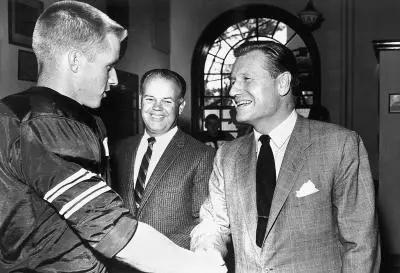
When it comes to building a championship program, Bob Blackman is unsurpassed in the history of Ivy League football.
Blackman was a relative coaching unknown when he arrived in Hanover in 1955 from the University of Denver, succeeding a wonderful gentleman coach, Tuss McLaughry, who had replaced the legendary Earl Blaik when Blaik moved to Army in 1940.
McLaughry had a run of success in the late 1940s but, from 1950-54, the years before formal Ivy League competition began (in 1956), Dartmouth had endured five losing seasons.
In 1955, Blackman's first team wasn't much better, finishing 3-6. But the foundation was being built with on-field imagination, especially on offense, that was being executed by players attracted to Dartmouth through a national recruiting effort, the likes of which the Ivy League had never seen.
It would be more than a decade before the rest of the league began to catch up with “Blackman Magic.” By the time he departed for Illinois in 1970, Blackman's 16 Dartmouth teams had produced seven Ivy titles, three undefeated seasons, two Lambert Trophy seasons as the East's best team, and an overall record of 104-37-3 that included a 79-24-2 mark in 15 Ivy seasons.
Over 52 seasons of Ivy play, Dartmouth has won or shared 17 Ivy titles, more than any other team. The first came in 1958 when the Green finished 7-2 overall and led the Ivy with a 6-1 record, clinching the title with road wins at Cornell and Princeton (both finished 5-2).
In 1957, led by All-America guard Joe Palermo, a team laden with sophomores and juniors had come close, building a 7-1-1 record (5-1-1 in the Ivy). The tie (at Yale, 14-14) was the difference between first and second place but a 34-14 loss at Princeton demonstrated that the Tigers were the better team.
Looking back, Bill Gundy (the junior quarterback in 1958), said, “We knew we had a well-balanced team with strong running backs (led by halfbacks Jake Crouthamel and Jim Burke and fullback Brian Hepburn), a passing game (Gundy's targets: Burke plus ends Scott Palmer and Bill Hibbs who were relied on more as blockers than receivers), and a solid line (center Bill Colehower, Capt. Al Krutsch and Bob Boye at guard, tackles Bill Pettway and Dave Bathrick). We had confidence in our ability and didn't really have any weaknesses.
“Al (Krutsch) was a strong captain and the defensive leader, not just because of his skills and strength but also for the passion with which he played,” said Gundy. “He showed the way with his 150 percent effort and energy but he also managed to keep an element of fun in the battle.”
Princeton, with its single wing offense (employed by no other teams), was still the preseason favorite. Bill (Moose) Morton, a senior halfback and periodic starter, said, “We had strong expectations but Sports Illustrated said, ?The Indians are strong but not strong enough.'”
Time would tell. In the years preceding two-platoon football, Blackman's line coach, Jack Musick, had become adept at devising schemes to neutralize the Princeton attack that made the Tigers a perpetual nemesis.
Crouthamel, Burke and Gundy would get most of the recognition as the mainstays of the offense. Crouthamel, a three-year starter at halfback, would finish his career with a Dartmouth record of 1,763 yards (including 722 yards, also a season record, in 1958). His most memorable game was at Cornell when he carried 15 times for 140 yards and scored three touchdowns. Dartmouth won, 32-15, without throwing a single pass in the game and Crouthamel was named the national back-of-the-week by Sports Illustrated.
Gundy recalled, “Our line would have to be the unsung heroes (in 1958). They didn't get big press but they were really a balanced group (the starters averaged 198 pounds, a far cry from today's behemoths).”
Colehower, the 185-pound center, said, “Blackman trained us well. By the time the season started, the creative Blackman system was well honed to take on almost any team. Without us, the backs wouldn't have gone anywhere.”
Morton, who came from Syracuse, N.Y., had played most of his four-year career behind Burke at right halfback. As the Green headed to Ithaca, Blackman said, “We're going to play Cornell in Moose's back yard. He'll be the starter this week.”
“Burkie was a better all-around player,” said Morton. “For many years, I never fully appreciated Blackman's decision. It sure doesn't sound like someone who felt, a la Vince Lombardi, that ?winning is the only thing.'”
While Crouthamel ran for 140 yards, Morton added 58 in 14 carries. “We won that game up front. I distinctly remember Dave Bathrick (the biggest lineman at 6-3, 211) coming into the huddle and saying, ?Which way do you want to run? I can take this guy in front of me either way you want.'”
The Green's road to the penultimate game at Cornell and the 21-12 title-clinching win at Princeton a week later include five wins and a couple of frustrating losses.
Dartmouth opened with a rain-soaked 20-0 win over Lafayette at Memorial Field and then edged past Penn, 13-12, a game decided by Hepburn's conversion that gave the Green a 7-6 halftime lead. The teams exchanged scores in the third period but both missed two-point conversion tries.
After another 20-0 win, this time at Brown, Dartmouth had two weeks of frustration. The Green was stalemated with Holy Cross, 8-8, in the third period when a drive to the Crusaders four stalled. Hepburn's field goal try was deflected into the hands of a HC reserve fullback, John Esposito, who took the ball 81 yards for the deciding score. Holy Cross won, 14-8, at Memorial Field.
At Harvard, the field was mud and mire as Gundy's eight-yard run and his conversion pass to Burke gave Dartmouth an 8-0 halftime lead. In the third period, an offside penalty against Dartmouth kept a Crimson drive alive to the tying score. In the fourth period, an interception of the rain-soaked ball at the Green 16 opened the way for Crimson halfback Chet Boulris to score (he also ran for the two-point conversion) to seal Harvard's 16-8 victory.
The frustration ended at Yale Bowl where Dartmouth won for the first time in five years, 22-14, as Burke scored on a 35-yard pass from Gundy and a three-yard run. The Green had a 22-0 lead at halftime after Hepburn scored from the two. Yale's rally in the second half was insufficient.
In a 38-0 rout of Columbia in the home finale, Crouthamel scored twice, setting up one TD with a 62-yard punt return. Dartmouth led, 16-0, at halftime. The Lions threatened in the third period but the defense, led by Krutsch, tackle Lee Horschman and end Roger Hanlon stifled the last serious drive. The Green scored 22 unanswered points in the final period.
Dartmouth, Cornell and Princeton were all 4-1 in Ivy games as the Green arrived at Schoellkopf Field in Ithaca. Cornell was coming off a 12-8 loss at Brown and didn't have an answer for Crouthamel, Morton and the rest of the Green ground game. Dartmouth ran the ball 51 times and didn't attempt a pass. Crouthamel (140) and Morton (58) had most of the Green's 246 rushing yards and sophomore halfback Al Rozycki's interception return provided icing points in the 32-15 victory.
Now it was showdown time at Palmer Stadium and Dartmouth was ready. On the second play from scrimmage, Crouthamel moved behind a wall of blockers. He covered 55 yards before he was caught at Princeton's three. Two plays later, Gundy scored.
Princeton responded to take a 12-6 lead in the third period but Dartmouth regained the lead on a 23-yard pass from Gundy to end Seth Strickland and Hepburn's conversion kick. In the final period, Gundy's fourth-and-12 pass to Crouthamel (off a fake punt by Gundy) set the stage for Morton who covered the last 14 yards and then added two conversion points to clinch the game, 21-12.
“We never had a problem getting up for Princeton,” said Gundy. “This was a ?must' win and we wanted to make amends for the loss the previous year.” The near-miss in 1957 had been avenged. On November 22, 1958, the Green had their first Ivy title.
Thirty-six days later, on December 28, 1958 at Yankee Stadium, the Baltimore Colts and New York Giants played for the NFL championship in what has been called the greatest game in NFL history.
As far as Dartmouth's 1958 team is concerned, history had already been made.
Jack DeGange is a freelance writer. He was sports information director at Dartmouth from 1968-77.
When it comes to building a championship program, Bob Blackman is unsurpassed in the history of Ivy League football.
Blackman was a relative coaching unknown when he arrived in Hanover in 1955 from the University of Denver, succeeding a wonderful gentleman coach, Tuss McLaughry, who had replaced the legendary Earl Blaik when Blaik moved to Army in 1940.
McLaughry had a run of success in the late 1940s but, from 1950-54, the years before formal Ivy League competition began (in 1956), Dartmouth had endured five losing seasons.
In 1955, Blackman's first team wasn't much better, finishing 3-6. But the foundation was being built with on-field imagination, especially on offense, that was being executed by players attracted to Dartmouth through a national recruiting effort, the likes of which the Ivy League had never seen.
It would be more than a decade before the rest of the league began to catch up with “Blackman Magic.” By the time he departed for Illinois in 1970, Blackman's 16 Dartmouth teams had produced seven Ivy titles, three undefeated seasons, two Lambert Trophy seasons as the East's best team, and an overall record of 104-37-3 that included a 79-24-2 mark in 15 Ivy seasons.
Over 52 seasons of Ivy play, Dartmouth has won or shared 17 Ivy titles, more than any other team. The first came in 1958 when the Green finished 7-2 overall and led the Ivy with a 6-1 record, clinching the title with road wins at Cornell and Princeton (both finished 5-2).
In 1957, led by All-America guard Joe Palermo, a team laden with sophomores and juniors had come close, building a 7-1-1 record (5-1-1 in the Ivy). The tie (at Yale, 14-14) was the difference between first and second place but a 34-14 loss at Princeton demonstrated that the Tigers were the better team.
Looking back, Bill Gundy (the junior quarterback in 1958), said, “We knew we had a well-balanced team with strong running backs (led by halfbacks Jake Crouthamel and Jim Burke and fullback Brian Hepburn), a passing game (Gundy's targets: Burke plus ends Scott Palmer and Bill Hibbs who were relied on more as blockers than receivers), and a solid line (center Bill Colehower, Capt. Al Krutsch and Bob Boye at guard, tackles Bill Pettway and Dave Bathrick). We had confidence in our ability and didn't really have any weaknesses.
“Al (Krutsch) was a strong captain and the defensive leader, not just because of his skills and strength but also for the passion with which he played,” said Gundy. “He showed the way with his 150 percent effort and energy but he also managed to keep an element of fun in the battle.”
Princeton, with its single wing offense (employed by no other teams), was still the preseason favorite. Bill (Moose) Morton, a senior halfback and periodic starter, said, “We had strong expectations but Sports Illustrated said, ?The Indians are strong but not strong enough.'”
Time would tell. In the years preceding two-platoon football, Blackman's line coach, Jack Musick, had become adept at devising schemes to neutralize the Princeton attack that made the Tigers a perpetual nemesis.
Crouthamel, Burke and Gundy would get most of the recognition as the mainstays of the offense. Crouthamel, a three-year starter at halfback, would finish his career with a Dartmouth record of 1,763 yards (including 722 yards, also a season record, in 1958). His most memorable game was at Cornell when he carried 15 times for 140 yards and scored three touchdowns. Dartmouth won, 32-15, without throwing a single pass in the game and Crouthamel was named the national back-of-the-week by Sports Illustrated.
Gundy recalled, “Our line would have to be the unsung heroes (in 1958). They didn't get big press but they were really a balanced group (the starters averaged 198 pounds, a far cry from today's behemoths).”
Colehower, the 185-pound center, said, “Blackman trained us well. By the time the season started, the creative Blackman system was well honed to take on almost any team. Without us, the backs wouldn't have gone anywhere.”
Morton, who came from Syracuse, N.Y., had played most of his four-year career behind Burke at right halfback. As the Green headed to Ithaca, Blackman said, “We're going to play Cornell in Moose's back yard. He'll be the starter this week.”
“Burkie was a better all-around player,” said Morton. “For many years, I never fully appreciated Blackman's decision. It sure doesn't sound like someone who felt, a la Vince Lombardi, that ?winning is the only thing.'”
While Crouthamel ran for 140 yards, Morton added 58 in 14 carries. “We won that game up front. I distinctly remember Dave Bathrick (the biggest lineman at 6-3, 211) coming into the huddle and saying,
?Which way do you want to run? I can take this guy in front of me either way you want.'” The Green's road to the penultimate game at Cornell and the 21-12 title-clinching win at Princeton a week later include five wins and a couple of frustrating losses.
Dartmouth opened with a rain-soaked 20-0 win over Lafayette at Memorial Field and then edged past Penn, 13-12, a game decided by Hepburn's conversion that gave the Green a 7-6 halftime lead. The teams exchanged scores in the third period but both missed two-point conversion tries.
After another 20-0 win, this time at Brown, Dartmouth had two weeks of frustration. The Green was stalemated with Holy Cross, 8-8, in the third period when a drive to the Crusaders four stalled. Hepburn's field goal try was deflected into the hands of a HC reserve fullback, John Esposito, who took the ball 81 yards for the deciding score. Holy Cross won, 14-8, at Memorial Field.
At Harvard, the field was mud and mire as Gundy's eight-yard run and his conversion pass to Burke gave Dartmouth an 8-0 halftime lead. In the third period, an offside penalty against Dartmouth kept a Crimson drive alive to the tying score. In the fourth period, an interception of the rain-soaked ball at the Green 16 opened the way for Crimson halfback Chet Boulris to score (he also ran for the two-point conversion) to seal Harvard's 16-8 victory.
The frustration ended at Yale Bowl where Dartmouth won for the first time in five years, 22-14, as Burke scored on a 35-yard pass from Gundy and a three-yard run. The Green had a 22-0 lead at halftime after Hepburn scored from the two. Yale's rally in the second half was insufficient.
In a 38-0 rout of Columbia in the home finale, Crouthamel scored twice, setting up one TD with a 62-yard punt return. Dartmouth led, 16-0, at halftime. The Lions threatened in the third period but the defense, led by Krutsch, tackle Lee Horschman and end Roger Hanlon stifled the last serious drive. The Green scored 22 unanswered points in the final period.
Dartmouth, Cornell and Princeton were all 4-1 in Ivy games as the Green arrived at Schoellkopf Field in Ithaca. Cornell was coming off a 12-8 loss at Brown and didn't have an answer for Crouthamel, Morton and the rest of the Green ground game. Dartmouth ran the ball 51 times and didn't attempt a pass. Crouthamel (140) and Morton (58) had most of the Green's 246 rushing yards and sophomore halfback Al Rozycki's interception return provided icing points in the 32-15 victory.
Now it was showdown time at Palmer Stadium and Dartmouth was ready. On the second play from scrimmage, Crouthamel moved behind a wall of blockers. He covered 55 yards before he was caught at Princeton's three. Two plays later, Gundy scored.
Princeton responded to take a 12-6 lead in the third period but Dartmouth regained the lead on a 23-yard pass from Gundy to end Seth Strickland and Hepburn's conversion kick. In the final period, Gundy's fourth-and-12 pass to Crouthamel (off a fake punt by Gundy) set the stage for Morton who covered the last 14 yards and then added two conversion points to clinch the game, 21-12.
“We never had a problem getting up for Princeton,” said Gundy. “This was a ?must' win and we wanted to make amends for the loss the previous year.” The near-miss in 1957 had been avenged. On November 22, 1958, the Green had their first Ivy title.
Thirty-six days later, on December 28, 1958 at Yankee Stadium, the Baltimore Colts and New York Giants played for the NFL championship in what has been called the greatest game in NFL history.
As far as Dartmouth's 1958 team is concerned, history had already been made.
Jack DeGange is a freelance writer. He was sports information director at Dartmouth from 1968-77.
Tuesday, May 26
Sunday, May 03
Saturday, May 02
Wednesday, April 29