Molly Reckford's path to the top of the sport of rowing has been far from typical.
The 2015 Dartmouth graduate initially entered the workforce, then fell back in love with rowing, before multiple times finding herself on the national stage representing the United States. The latest chapter begins Sept. 3 at the World Rowing Championships in Belgrade, Serbia.
"Just about three years after graduation, my boss mentioned that our office was really close to the Stanford boathouse," said Reckford. "She knew I had been a rower and said I should see if could row there."
Reckford loved the idea and saw it as an opportunity to meet some friends and spend some time around a former passion of hers.
It quickly became something bigger.
"Some master's rowers saw me, said I looked athletic and wanted me to join their competitive sweep program," she said. "I wasn't sure if I wanted to be on a competitive team again, but I joined their program and also took out a single once or twice by myself and fell head-over-heels back in love with it."
This came in 2018 — following three years of working full-time.
"I ended up competing with the master's team at the master's national championships and won every event I entered," said Reckford. "It was a level of success I had never seen before.
"I wondered if I was fast enough to make a go for the national team."
During her college days, Reckford's head coach at Dartmouth (Wendy Bordeau) had encouraged her to row the single over the summers.
When Reckford rowed the single, it was at the Nereid Boat Club in Rutherford, New Jersey.

"The coach there saw something in me and said he thought I could be a national team athlete," said Reckford. "I said that's a joke; that's impossible, it's never going to happen. But that comment from him bubbled up again [years later in California]."
Rowing the single in her college days would pay off. It allowed Reckford to learn sculling, which is rowing with two oars, something that she would go on to do post-graduation. College racing features sweep rowing, using one oar.
Flash forward to around three years after graduation. Because of how much fun Reckford was having rowing again, she began to think about what it would take to represent the U.S.
"I was doing this six days a week every morning at 5 a.m. before work just because I loved it," she said. "At that point, lightweight rowing was going to be taken out of the Olympics after Tokyo, so there was one shot for me as a lightweight and this was it. I buckled down and trained a lot harder. Then, spring, 2019 rolled around and I went to my first national team selection event and got seventh place."
Reckford did the math on how many seats there were for lightweight women scullers at the world championships.
The answer?
Seven.
"I knew I might actually be able to make the national team," said Reckford. "In 2019, I ended up stroking, so setting the rhythm, in the lightweight women's quad. From there, it has been an epic journey of finding coaches, finding partners, changing locations and trying to set myself up as well as possible to get where I need to be."
One place Reckford has been is the Olympics, competing in the 2020 Tokyo games (which happened in the summer of 2021).
"Going to the Olympics, winning the final Olympic qualifier in order to go, was one of my career highlights for sure," she said. "Because there are caps on the number of athletes, the Olympic regatta is actually smaller than the world championships regatta, so it's more intimate. You really feel special and you really feel like you're one of the top athletes if you make it."

Reckford admits there's a time she wasn't one of the top athletes. Over the course of her Dartmouth career, she rowed in numerous boats, primarily the second varsity eight. She enjoyed some success, but her success has skyrocketed since graduation.
"In some ways, what I bring to the table now is something I was lacking at Dartmouth," said Reckford. "I think right now, I really bring a commitment to putting in the work. I have a friend who often has to tell me to stop and rest.
"I'm very driven, very passionate about rowing and very competitive, but when I was at Dartmouth, I really struggled with internal intrinsic motivation," Reckford continued. "I wanted to win, I wanted to prove myself, I wanted to fight and I wanted to prove other people wrong, but it was not the right attitude."
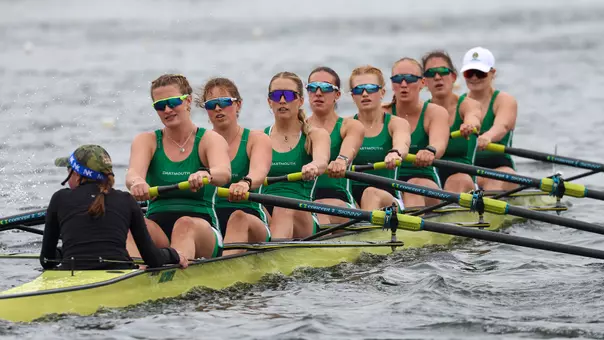
For this year's world championships, Reckford will be rowing in the women's quad, a different event than the lightweight double, which she has been a staple in.
Reckford reacted to the news differently than she likely would have reacted back in her Dartmouth days.
"I had a day or two to be sad, then I said it's time to get a new goal," she said. "It's time to make this an opportunity. It's time to turn this into a blessing."
Reckford has done just that, who is loving her teammates within the women's quad — a boat class without weight limits.
"I am having an absolutely fantastic time with my quad," she said. "Things are going really well and I'm really excited about it. One of our soft goals for the world championships is to keep our culture, even when everybody else gets stressed. This group of women is absolutely fantastic and everybody can really stay positive; even if there's tension, we can diffuse it quite quickly.
"And our main goal is to qualify this boat for the Olympics, which is a top-seven finish."
So many aspects of Reckford's path aren't typical, including moving from a lightweight to an open weight boat.
"When I earned my seat in the quad, I had been a lightweight three days earlier, so it's not like I got any bigger," she said. "It's really about how you move, how you use your body and what your weight-to-watt is.
"Don't let people tell you you're too small."
Don't let people tell you what's "typical" either. It's okay to make your own path, much like Reckford, who was arguably more prepared for success due to the three-year hiatus after college.

"The cardiovascular system of a human actually doesn't finish developing until you're about 30 or 32 years old," she said. "Rowing is a very cardiovascular-based sport, and there's also strength involved and technique. A lot of rowers leave college, they're good and they immediately go out and try to make a national team. That means it's hard to work full time and you have to be located where a training center or high-performance club is.
"You grind like that for three, four, five years and most people, even very gifted athletes, probably won't make the team their first try or two," Reckford continued. "Whereas my path of being completely unnoticed, not being worth a second look then taking three years to grow and develop, meant that when I came back to rowing, I hadn't put all that volume and years of training on my body."
Reckford is now 30 and doesn't have a lot of the chronic injuries that many other 30-year-olds have.
"But I do have an almost fully-developed cardio system," she said. "You don't have to be good in college or high school to love a sport and dedicate yourself fully to it once you have finished paying your student loans and established a home somewhere."
Post Dartmouth, Reckford's home included New York then California.
"I went to New York and got a job at Citi, actually through the Dartmouth Peak Performance Program," she said. "Citi wanted to hire Dartmouth athletes, I responded to an email and pretty quickly found myself submitting resumes and doing a Super Day in New York. About three days after graduation, I started at Citi in sales and trading. That job brought me to San Francisco and I fell in love with California."
To make associate, Reckford would have to go back to New York, but she had fallen in love with San Francisco. Reckford went on to become a research analyst at Aetos Alternatives Management, an asset manager in Menlo Park, California before leaving that role to focus full-time on training for the 2020 Olympics. After COVID delayed the Olympics, she jumped back into parti-time work at Aetos until 2022.
"I currently work for Broadridge Financial in a partnership with USRowing," she said. "I work about 20-25 hours a week, on top of my rowing career."
When Reckford's rowing career is over, she will undoubtedly be set up for success.
"The joke I like to tell is the three-year taper is the way to go because of my three years off from rowing," she said. "I had a business career. I can point to projects that I've been on and can speak intelligently about the subjects I've worked on.
"I'm confident that I can go back and restart my career once rowing is over," Reckford continued. "Rowing will be a really beautiful asterisk on my resume and not the only thing on my resume."
For now, Reckford's rowing career has some more chapters to write.