Teevens Center Hosts Inaugural Research Forum
12/11/2025 11:06:00 AM | Athletics
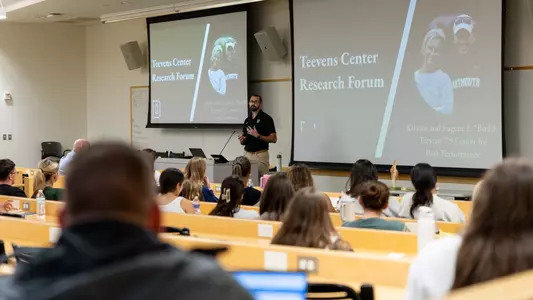
HANOVER, N.H. — On November 4, the Teevens Center for Peak Performance hosted its inaugural Research Forum, bringing together Dartmouth students, faculty, coaches, clinicians and athletics staff to explore cutting-edge work in health, wellness and human performance.
The event marked the formal launch of Pillar III of the Teevens Center mission: advancing research and innovation in performance science. In his opening remarks, Duncan Simpson, the Director of the Kirsten and Eugene F. "Buddy" Teevens '79 Center for Peak Performance highlighted the forum's purpose to "increase awareness of the great work already happening, spark new ideas around the performance problems we want to solve and foster collaboration across disciplines and expertise."
The forum also honored the legacy of Coach Buddy Teevens, whose forward-thinking approach positioned research as a catalyst for solving real-world challenges and enhancing student-athlete well-being.
A Cross-Campus Community Comes Together
A defining feature of the inaugural forum was the diversity of the participants. Student-athletes, faculty members, athletics and campus staff, Dartmouth Health clinicians and coaches filled the room, united by a shared commitment to advancing performance and well-being. The variety of perspectives reflected the center's vision: to foster faculty-student partnerships, encourage interdisciplinary inquiry and support research that meaningfully impacts student health and performance.
Presentation 1: ACL Injury Risk in Female Athletes
The first presentation highlighted an exceptional faculty-student research collaboration between Emma Symon '26, a member of Dartmouth's volleyball's team, and Professor Nathaniel Dominy, Chair of Anthropology and Faculty Athletics Representative. Their research investigates why female athletes experience ACL injuries at higher rates and examines hormonal, biochemical and structural contributors to knee instability.
Using 3D motion-capture technology in Dartmouth's DREAM Studio, the team is exploring whether hormonal changes, particularly the rise of relaxin during the luteal phase, affect knee mechanics. Early findings indicate:
Presentation 2: Reducing Head-Impact Exposure in College Football
The second presentation of the day, led by Ben Schuler, Dartmouth's Director of Sports Medicine, and Dr. Jonathan Lichtenstein, Director of Neuropsychological Services at DHMC and Assistant Professor, examined Dartmouth football's pioneering work to reduce head-impact exposure.
Drawing on peer-reviewed findings, they detailed how tackling techniques influence concussion risk and how Dartmouth's "no player-on-player tackling" philosophy, championed by Coach Teevens, has reshaped both player safety and competitive performance.
Key insights included:
A Foundation for Future Innovation
With more than 60 attendees and lively Q&A exchanges, the inaugural forum succeeded in building community, sharing evidence-based insights, and identifying emerging research questions. Simpson closed with a challenge to the group: "We want to ask great questions and solve problems that will have an impact on the health, wellness and performance of our Dartmouth students."
The Teevens Center will continue hosting a research forum each term, with an eye toward developing an annual Teevens Research Conference that establishes Dartmouth as a national leader in performance science.
If this first event is any indication, the future of performance research at Dartmouth is collaborative, ambitious and firmly rooted in the values Coach Teevens championed.
The event marked the formal launch of Pillar III of the Teevens Center mission: advancing research and innovation in performance science. In his opening remarks, Duncan Simpson, the Director of the Kirsten and Eugene F. "Buddy" Teevens '79 Center for Peak Performance highlighted the forum's purpose to "increase awareness of the great work already happening, spark new ideas around the performance problems we want to solve and foster collaboration across disciplines and expertise."
The forum also honored the legacy of Coach Buddy Teevens, whose forward-thinking approach positioned research as a catalyst for solving real-world challenges and enhancing student-athlete well-being.
A Cross-Campus Community Comes Together
A defining feature of the inaugural forum was the diversity of the participants. Student-athletes, faculty members, athletics and campus staff, Dartmouth Health clinicians and coaches filled the room, united by a shared commitment to advancing performance and well-being. The variety of perspectives reflected the center's vision: to foster faculty-student partnerships, encourage interdisciplinary inquiry and support research that meaningfully impacts student health and performance.
Presentation 1: ACL Injury Risk in Female Athletes
The first presentation highlighted an exceptional faculty-student research collaboration between Emma Symon '26, a member of Dartmouth's volleyball's team, and Professor Nathaniel Dominy, Chair of Anthropology and Faculty Athletics Representative. Their research investigates why female athletes experience ACL injuries at higher rates and examines hormonal, biochemical and structural contributors to knee instability.
Using 3D motion-capture technology in Dartmouth's DREAM Studio, the team is exploring whether hormonal changes, particularly the rise of relaxin during the luteal phase, affect knee mechanics. Early findings indicate:
- Oral contraceptive use may improve knee stability two-fold, resulting in more consistent landing patterns.
- Knee asymmetry peaks during the luteal phase for athletes not using oral contraceptives, mirroring hormonal changes.
Presentation 2: Reducing Head-Impact Exposure in College Football
The second presentation of the day, led by Ben Schuler, Dartmouth's Director of Sports Medicine, and Dr. Jonathan Lichtenstein, Director of Neuropsychological Services at DHMC and Assistant Professor, examined Dartmouth football's pioneering work to reduce head-impact exposure.
Drawing on peer-reviewed findings, they detailed how tackling techniques influence concussion risk and how Dartmouth's "no player-on-player tackling" philosophy, championed by Coach Teevens, has reshaped both player safety and competitive performance.
Key insights included:
- Dartmouth football players use the highest-risk tackle combinations far less frequently than other Ivy League teams.
- Incorporating the MVP tackling dummy significantly reduced practice and in-game concussions.
- These safety innovations coincided with major competitive success, including five Ivy League championships from 2015–2024.
A Foundation for Future Innovation
With more than 60 attendees and lively Q&A exchanges, the inaugural forum succeeded in building community, sharing evidence-based insights, and identifying emerging research questions. Simpson closed with a challenge to the group: "We want to ask great questions and solve problems that will have an impact on the health, wellness and performance of our Dartmouth students."
The Teevens Center will continue hosting a research forum each term, with an eye toward developing an annual Teevens Research Conference that establishes Dartmouth as a national leader in performance science.
If this first event is any indication, the future of performance research at Dartmouth is collaborative, ambitious and firmly rooted in the values Coach Teevens championed.


Sunday, September 13
Sunday, September 13
Sunday, September 13
Friday, September 11