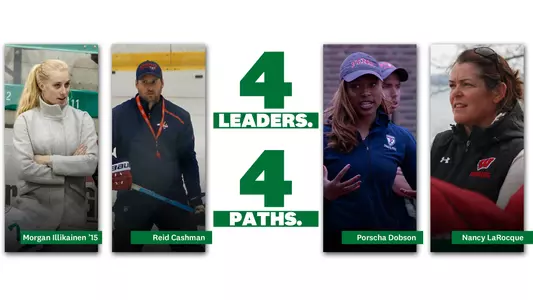
PEAK Magazine Feature: 4 Leaders. 4 Paths.
12/15/2020 10:00:00 AM | Men's Cross Country, Men's Ice Hockey, Men's Track & Field, Women's Cross Country, Women's Ice Hockey, Women's Rowing, Women's Track & Field, Peak Performance
A look four new names and faces at the helm of Big Green programs.
From the Fall 2020 issue of PEAK Magazine, released in November.
A quartet of new coaches arrived in Hanover in the past four months, all following distinctly different paths. There has likely never been a more unique time to assume a head coaching role and as each continues to settle in and begin building their programs, the similarity of their experiences and goals is striking.
For Reid Cashman, Koenig Family Head Coach of Men's Hockey, his journey to Dartmouth included a restart of his previous role in the NHL, serving as an assistant coach with the Washington Capitals over the summer, while women's rowing coach Nancy LaRocque, the next hire, found a return to New England via Wisconsin. In August, Dartmouth announced that Morgan Illikainen '15, who previously served as an assistant coach, would return as interim head coach, while the most recent hire, Marjorie & Herbert Chase '30 Director of Dartmouth Track & Field and Cross Country Porscha Dobson, traded Ivy affiliations for her first head coaching job.A quartet of new coaches arrived in Hanover in the past four months, all following distinctly different paths. There has likely never been a more unique time to assume a head coaching role and as each continues to settle in and begin building their programs, the similarity of their experiences and goals is striking.
What motivated you to look into this opportunity at Dartmouth?
LaRocque: Dartmouth, as a Division I rowing program, has immense and untapped potential, especially given the resources and facilities we have in place. I felt pretty confident that we can get the program back on the national stage. Personally, the location was appealing and provided an opportunity to come back home to New England and do what I love.
Dobson: Being in the Ivy League already at Penn, I had the opportunity to observe each school and identify the uniqueness of Dartmouth up close. Dartmouth has had success through the years and much like when I arrived at Penn, I saw an opportunity to build a championship-caliber program in the conference and region and feel like I have an advantage knowing who we need to recruit, having been through that trial and error process already in the Ivy League.
Cashman: On a personal level, my wife is from New Hampshire and we have made our (off-season) home here for the last few years. We saw this as a chance to get back home fulltime and raise our kids in a great community like Hanover. On the hockey side, Dartmouth has the ability to win championships and when you consider the entire history of the program, it is unrivaled in college hockey. There is great administrative support, and we know that we will build something special here.
Illikainen: As a graduate of Dartmouth and a student-athlete of the program, as well as an assistant coach for two seasons, I love the spirit and people of Dartmouth and want to provide a positive, inspiring, rewarding experience for our student-athletes. Our program has a long tradition of excellence, and I strive to build upon that. I feel a great responsibility of care for the direction of this team stepping into this role.
As you went through the interview process, what was the most surprising thing you learned?
LaRocque: It was definitely the support of the alumni. That was incredible to understand. The year-to-year support we receive and what it will allow us to do is a difference maker.
Cashman: I agree; the alumni are fiercely loyal and passionate, and the resources they provide are incredible. Our alumni are leaders in virtually every industry but as busy as they are, they are engaged with the program is a meaningful way and really want the current and future players to have the same or better experience than they did.
Dobson: During the interviews, one of the things I realized that made Dartmouth unique is the size of the school. While it is smaller than the other Ivies, there is a powerful correlation between that and the close-knit relationship and culture that the student-athletes have with each other. That is one of the things that distinguishes Dartmouth, especially coming from a larger, urban institution.
Illikainen: Level of support for our program and commitment to our development and success. Level of care for the safety of our students and community - trying to make the best SA experience that is possible right now amidst this pandemic - level of support as students and athletes.
What are your main goals in your first year as head coach?
LaRocque: For a some of the rowers, I am the fourth coach they have interacted with during their time at Dartmouth, so I think it's important to establish some consistency and find ways to improve in this challenging year. We want to focus on some low-hanging fruit, like defining what it means to be a Dartmouth rower, from how you carry a boat to how you present yourself on campus. Trying to establish a culture in a virtual setting isn't the best way for a new coach, but everyone is staying positive and, for those who are here, we are working hard to have fun and spread that positivity through the entire team.
Dobson: For me, it is about capitalizing on the passion and building a better team culture. We want to do things better than they've ever been done before, starting with the little things. For our student-athletes, I want them to build an identity where they all feel like contributors to the program and are elevating themselves. It's really about hitting "refresh" and moving forward, feeding off the energy and newness that comes with a new coach.
Cashman: This fall, we've had the ability to break things down to the basics and implement habits that are important to our staff. We ask our players to maximize who they are on that particular day through self-evaluation and have a "next-play/next-day" mentality. Because of the world we are in right now, everyone is dealing with a lot of adversity and it's been a great theme for the program. We want our guys to attack adversity and have that mentality become part of our program so that, down the road, we won't break stride when we face tough situations. That sets us up for long-term success.
Illikainen: As a first-year head coach, my top priority during this unprecedented time is to maintain the health and well-being of our student-athletes, staff, and community. From there, I have really been focused on building a positive team culture, focusing on supporting all of our student-athletes around COVID uncertainty. One of the biggest and most important pieces is focusing on new ways to engage around recruiting in this virtual landscape so we can continue to bring impactful players to Hanover. There's no shortage of work, but the main focus is on our student-athletes.
What are some of the challenges in trying to build relationships and move forward with your student-athletes during the pandemic?
Dobson: There are always going to be some challenges. A lot of my interactions have obviously been over Zoom, but I think there are perks to that. With a team of over 100 student-athletes, being able to break into groups and have more intimate conversations has been a real positive. The student-athletes have been appreciative of that because it allows us to communicate on a more personal level. Track and field was the first program to have access to the facilities, so the face-to-face interaction with the other coaches adds hope and excitement moving forward. It is very tough for our athletes to train on their own; people understand track and field to be an individual sport but collegiate track and field is very much a team sport and without that camaraderie, we are doing out best to meet and communicate to increase engagement. Even simple things like being more active on social media helps because we want to encourage the team to be their own biggest fans.
LaRocque: Under normal circumstances, we would be out in bigger boats, but we can't do that right now. We have been fortunate to secure singles to row, so our kids can be out on the water. Being in singles really does fine tune your technique. While I'd love to have our entire team on campus and training together, we wouldn't be able to row in singles with our full roster of 45-50 student-athletes on campus. The uncertainty is the hardest part for everyone, but we are doing our best to take things one term at a time.
Cashman: The biggest challenge is the unknown. Every day things are changing and out of our control in terms of what we are doing as a program and as a college. Coaches can't be on the road recruiting, which is a big part of our plan, but we've tried to take advantage of the situation and spend more time with the current team and get to know them as well as we possibly can.
Illikainen: I am fortunate to have worked with most of the student-athletes in my previous capacity as an assistant coach. The biggest challenge is obviously building those relationships in a virtual world and transitioning into the head coaching role. Zoom isn't the same as human interaction and it makes it harder for us to feed off each other's energy, read the room and build trust as effectively as we would under normal circumstances. Each of our players have different resources at their disposal so we are really trying to fill in the gaps and provide the same level of support to everyone.

2024 Dartmouth Athletics DRIVE Program
Friday, September 13
NCAA Diversity and Inclusion Social Media Campaign: Day 3
Sunday, October 22
NCAA Diversity and Inclusion Social Media Campaign: Day 2
Sunday, October 22
NCAA Diversity and Inclusion Social Media Campaign: Day 1
Sunday, October 22