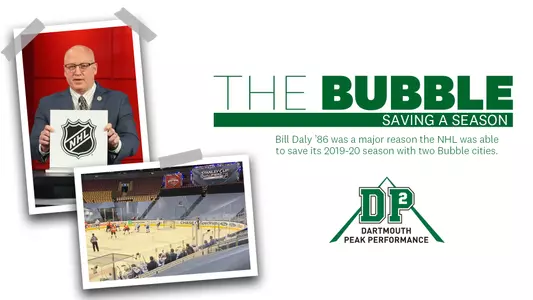
Photo by: Dartmouth
PEAK Magazine Feature: Bill Daly ’86 and the NHL Bubble
5/14/2021 10:01:00 AM | Football, Men's Ice Hockey, Athletics, Peak Performance
The former Dartmouth football player now plays a major role in making the NHL run smoothly.
So much has been written about the execution of professional sports in the middle of COVID and the major professional sports franchises have pulled it off with varying levels of success, all of which is subjective based on an individual's passion for the sport and personal attitude toward the pandemic. The NBA had its early hiccups last summer before things smoothed out right through the playoffs. Major League Baseball also had its own issues early on and perhaps its most controversial on the same night it crowned a champion back in the fall. The NFL moved forward, despite multiple issues related to a rise in cases throughout the country and weekly occurrences within its teams.
The National Hockey League (NHL), however, can claim victory with a below-the-radar status relative to its peers. From August 1 until the end of September, the NHL staged 130 games in 59 days – and most importantly, administered over 33,000 COVID tests without a single positive result. At the center of the planning and execution of the flawless playoffs was NHL Deputy Commissioner Bill Daly '86. As he's done before, Daly has once again saved the NHL.
Unlike his role in labor negotiations previously, this effort was truly new territory. It started with a collaborative approach between the NHL Players' Association and the league office, an increasingly less common occurrence in the current professional sports environment. Using a pair of hub cities – Edmonton and Toronto – the successful execution began with unilateral support for mask wearing, social distancing and, in the case of players and team personnel, isolation from family and friends for over two months.
"I was part of a relatively small core group that worked through the numerous and varied COVID-related issues that not only faced our sport, but virtually every industry," said Daly. "I met with my team regularly and we worked through various phases of protocol that were necessary to execute our Return to Play plan.
"It was a unique experience and our efforts were successful — at least relatively speaking. But it's not something I ever want to have to repeat."
Daly was also quick to deflect credit to the league, recognizing that without a collaborative effort, success would have been impossible.
"The protocols we developed were sound, well thought out and practical," said Daly. "But they were successful only because of the buy-in we got from our constituents. The real credit goes to our players, the club staffs and our league staff, each of whom made incredible personal sacrifices to make the plan a success."
Current Koenig Family Head Coach of Dartmouth Men's Hockey Reid Cashman had an opportunity to experience things firsthand, as he returned to his post as an assistant coach with the Washington Capitals for the playoff run before turning his focus back to the Big Green. Cashman could not have been more impressed with the plan and its execution.
"The league made it really easy for us to do our job in the Bubble," said Cashman, who was situated in one of two bubbles in Toronto for the restart of the season. "It was so well organized and everything we needed to succeed – from testing to nutrition to meeting space to video – was available to us. The league gave us all the resources we needed to do our job and stay focused on the Stanley Cup."
Reflective of the comprehensive nature of the program, there were very few and minor instances of non-compliance, according to Daly, and each of those were dealt with appropriately and, with very few exceptions, were non-recurring.
"I found that there was very little policing that needed to be done, at least within our team," said Cashman. "We had everything we needed and because of the opportunity to play for and win the Stanley Cup, there was enough motivation for players and no reason to break protocol or put themselves of their teammates at risk."
As the US and Canada worked through the various challenges in day-to-day life, what was happening in the NHL was having a much larger impact on society. The ability to watch sporting events again, and know they were happening in a safe environment, gave hockey fans a respite from the difficult and unpleasant effects of the pandemic on everyday life. TV viewership was up – a clear indication that the NHL's efforts to play were appreciated.
"I think it was important to our fans that we made every effort to finish our season after five-plus months of regular-season play under our belts (October to mid-March)," said Daly. "We felt we owed it to our fans to make that effort, and to make it in a safe and responsible way, but also to create a format that would produce a competitively credible and entertaining end to the season. And we think we had success in doing that."
A 2-0 victory for the Tampa Bay Lightning over the Dallas Stars on September 28 capped an impressive two-month effort by the league and one that was lauded worldwide. While the Lightning players celebrated their Stanley Cup victory in more modest fashion than previous winners, the reward for Daly was much different – a chance to shift gears quickly and begin work on a 2021 season that started on January 13.
"The start of the 2021 season was a completely different challenge, one which required a completely different solution," said Daly. "We set out with a goal to start playing hockey again in January and we did that, the outcome a product of intensive discussions with our players and the NHLPA."
Not surprisingly, the second effort appears to be just as smooth as the first, and hockey fans worldwide can thank Daly's leadership in providing that. More than 30 years later, Daly still finds himself drawing on the lessons he learned on the gridiron at Dartmouth to inform decisions made in hockey venues across North America.
"I consider my Dartmouth experience to have been very instrumental in my later career path, in terms of commitment, determination, time management, relationship building and, perhaps most importantly, pursuit of your passion," said Daly. "Sports has always been a passion of mine."
Fortunately for millions of fans, that passion and those lessons are now guiding the NHL season through another successful campaign and giving the NHL another reason to make its fellow pro leagues a bit jealous.
The National Hockey League (NHL), however, can claim victory with a below-the-radar status relative to its peers. From August 1 until the end of September, the NHL staged 130 games in 59 days – and most importantly, administered over 33,000 COVID tests without a single positive result. At the center of the planning and execution of the flawless playoffs was NHL Deputy Commissioner Bill Daly '86. As he's done before, Daly has once again saved the NHL.
Unlike his role in labor negotiations previously, this effort was truly new territory. It started with a collaborative approach between the NHL Players' Association and the league office, an increasingly less common occurrence in the current professional sports environment. Using a pair of hub cities – Edmonton and Toronto – the successful execution began with unilateral support for mask wearing, social distancing and, in the case of players and team personnel, isolation from family and friends for over two months.
"I was part of a relatively small core group that worked through the numerous and varied COVID-related issues that not only faced our sport, but virtually every industry," said Daly. "I met with my team regularly and we worked through various phases of protocol that were necessary to execute our Return to Play plan.
"It was a unique experience and our efforts were successful — at least relatively speaking. But it's not something I ever want to have to repeat."
Daly was also quick to deflect credit to the league, recognizing that without a collaborative effort, success would have been impossible.
"The protocols we developed were sound, well thought out and practical," said Daly. "But they were successful only because of the buy-in we got from our constituents. The real credit goes to our players, the club staffs and our league staff, each of whom made incredible personal sacrifices to make the plan a success."
Current Koenig Family Head Coach of Dartmouth Men's Hockey Reid Cashman had an opportunity to experience things firsthand, as he returned to his post as an assistant coach with the Washington Capitals for the playoff run before turning his focus back to the Big Green. Cashman could not have been more impressed with the plan and its execution.
"The league made it really easy for us to do our job in the Bubble," said Cashman, who was situated in one of two bubbles in Toronto for the restart of the season. "It was so well organized and everything we needed to succeed – from testing to nutrition to meeting space to video – was available to us. The league gave us all the resources we needed to do our job and stay focused on the Stanley Cup."
Reflective of the comprehensive nature of the program, there were very few and minor instances of non-compliance, according to Daly, and each of those were dealt with appropriately and, with very few exceptions, were non-recurring.
"I found that there was very little policing that needed to be done, at least within our team," said Cashman. "We had everything we needed and because of the opportunity to play for and win the Stanley Cup, there was enough motivation for players and no reason to break protocol or put themselves of their teammates at risk."
As the US and Canada worked through the various challenges in day-to-day life, what was happening in the NHL was having a much larger impact on society. The ability to watch sporting events again, and know they were happening in a safe environment, gave hockey fans a respite from the difficult and unpleasant effects of the pandemic on everyday life. TV viewership was up – a clear indication that the NHL's efforts to play were appreciated.
"I think it was important to our fans that we made every effort to finish our season after five-plus months of regular-season play under our belts (October to mid-March)," said Daly. "We felt we owed it to our fans to make that effort, and to make it in a safe and responsible way, but also to create a format that would produce a competitively credible and entertaining end to the season. And we think we had success in doing that."
A 2-0 victory for the Tampa Bay Lightning over the Dallas Stars on September 28 capped an impressive two-month effort by the league and one that was lauded worldwide. While the Lightning players celebrated their Stanley Cup victory in more modest fashion than previous winners, the reward for Daly was much different – a chance to shift gears quickly and begin work on a 2021 season that started on January 13.
"The start of the 2021 season was a completely different challenge, one which required a completely different solution," said Daly. "We set out with a goal to start playing hockey again in January and we did that, the outcome a product of intensive discussions with our players and the NHLPA."
Not surprisingly, the second effort appears to be just as smooth as the first, and hockey fans worldwide can thank Daly's leadership in providing that. More than 30 years later, Daly still finds himself drawing on the lessons he learned on the gridiron at Dartmouth to inform decisions made in hockey venues across North America.
"I consider my Dartmouth experience to have been very instrumental in my later career path, in terms of commitment, determination, time management, relationship building and, perhaps most importantly, pursuit of your passion," said Daly. "Sports has always been a passion of mine."
Fortunately for millions of fans, that passion and those lessons are now guiding the NHL season through another successful campaign and giving the NHL another reason to make its fellow pro leagues a bit jealous.
Friday, August 28
Friday, August 28
Friday, August 21
Friday, August 21