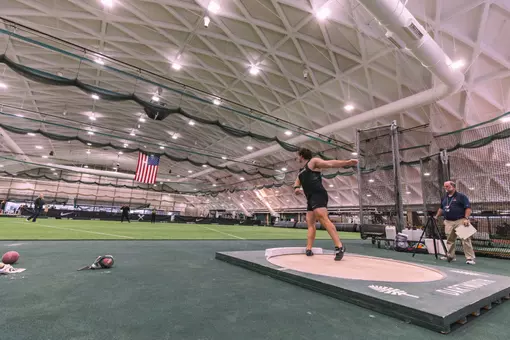
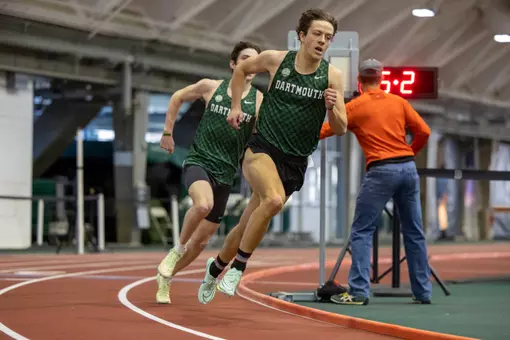
Jason Wang, who was born in Seattle and moved to Honolulu, wanted to experience something different for college.
"Tough to get too different when comparing Hawaii to New Hampshire," he said.
Wang is half Japanese, a quarter Chinese and a quarter white. May is Asian American and Pacific Islander Heritage Month.
"Especially living in Hawaii, that heritage was a part of my identity — with Hawaii being a melting pot of the Pacific, as well as my own family having that dynamic," he said. "We would celebrate the Japanese New Year with my maternal grandparents."
Wang is third and fourth generation removed on his parents' sides, admitting it wasn't a huge part of his cultural upbringing.
However, it has played a significant role in his life, especially in one particular way.
"A lot of my parents' values trickled down to me," said Wang. "There is a very strong sense of family and obligation to something greater than yourself."
That theme has carried Wang to success throughout his life, including at Dartmouth.
Wang just finished his fifth year as a member of the Big Green cross country, indoor and outdoor track teams.

"I came in as a very fringe runner," he said. "Early on, I definitely got my butt kicked pretty much every practice. What really helped me find a lot of joy in the sport at the collegiate level was a combination of two things.
"First, realizing running is fun; getting to compete at this level is something that I shouldn't take for granted," Wang continued. "Second was finding my primary event, the steeplechase, which is only in outdoor track."
Because of COVID, the 2022-23 school year was Wang's second season of running in any substantial capacity.
"Having running as a guiding light throughout my time at Dartmouth has been really helpful," he said.
Wang began running in Seattle, where he lived until middle school, but became more serious about it when he moved to Honolulu.
Running helped Wang find Dartmouth.
"Although I was interested in computer science, it became pretty apparent to me that I didn't want to go to a tech school," he said. "There are some small amounts of liberal arts schools with a strong computer science program. When I walked on campus here, I knew this could be home for me for the next four years.
"I had a really strong sense of place."
Dartmouth was a strong academic and athletic fit for Wang. Something else caught his attention when he spoke to Dartmouth students.
"Both athletes and nonathletes didn't only say things like they liked the school and it was a good school for them, but rather it was the best four years of their life," he said. "That was a pretty strong statement."
Dartmouth gave Wang a chance to be part of something bigger than himself, just like the values instilled in him by his parents.

"Distance running is in theory, a very solitary sport, but in reality, you're out on training runs with your best friends every day and you're going through the exact same things," he said. "If I'm not having a good workout, I ask myself how I can help my teammates make it a good one for them. If I'm not having a good race, what can I do to pull my teammates along?
"It helps to think of it in those terms rather than solely, 'I have to run well.'"
The people around Wang are a significant reason why he is back for a fifth year, following a gap year surrounding the COVID pandemic.
"I was really fortunate that I didn't have any pressure to get out of here as soon as I could," he said. "It felt like I would be shortchanging myself if I had anything less than four years in person on campus. The in-person experience is why I came here.
"I feel like I learn a great deal in my classes, but if I'm going to be doing Zoom classes, that takes a lot away from the professor-to-student interaction and student-to-student interaction, not to mention athletics and other aspects of being on campus," Wang continued.
In the classroom, Wang is a computer science and economics double major.
"I took a computer science class my freshman fall and economics class the next year, loved both of them and it was an easy decision," he said. "They were both areas of interest for me and they both set me up pretty well from a career perspective."
On the track, Wang has grown a love and interest in the steeplechase, which is essentially like an obstacle course that requires many different skill sets.
"It's 3,000 meters, just under two miles, so it falls under the specter of distance races, but there are five hurdles per lap," said Wang. "Unlike normal hurdles in track, they're big and wooden, and they don't move if you hit them. There are four of those and there's one more that's the same height, but there's a pit of water after. If you don't get a good plant off the barrier, you end up waist deep in water.
"The steeplechase is a unique combination," Wang continued. "Distance running is a bit of a prerequisite. There's a substantial degree of athleticism involved with the event that makes it a gritty event."
Wang compared the steeplechase to another area of interest… music.
"I particularly have an affinity for jazz music and jam music, and in the same way with running, you can have an expectation for what's going to happen," he said. "Having a very set expectation is something I sometimes struggle with internally. But in music, you never really know what's going to happen.
"The same is true in a race."

Life isn't scripted. For as much as you may think something will happen, life is truly unpredictable.
"You may get a third of the way through the steeplechase and clip a hurdle and fall," said Wang. "That's not part of the plan, that's not part of the expectation, but you have to roll with it. What I expected to happen didn't happen, but where do I go from here?
"Making these split-second decisions is the same as in music when you're improvising, or you're listening to the band and deciding where it's going," he continued. "You have to throw preconceived notions out the window. I try and keep myself open to any possibility and ready to roll with whatever happens."
Wang is referring to his playing music in an organized jazz band, with experience playing drums and bass guitar.
"I grew up around music," he said. "My mom is a musician, and my dad also plays piano. I started playing in an organized jazz band very shortly after I moved to Hawaii, so that was middle school through high school, which was another competitive outlet."
Wang is in several student bands at Dartmouth, one of which played at Green Key [music festival] this month.

"Music was a big part of my life in high school and I expected it to fall by the wayside a little bit with varsity athletics here, but I've been really fortunate I've been able to continue," he said.
After Dartmouth, Wang will be working in Philadelphia at a quantitative trading firm.
"Things I'll do on a day-to-day basis is try to find small advantages where I can, which has been a big aspect of track as well," he said. "I know my flat speed, meaning standard distance event, but improving my technique over hurdles and barriers affords me the ability to take on my event.
"Find a weakness and turn it into a strength, and find these little areas where I can get an edge and improve myself a little bit more," Wang continued.
When asked what keeps him going, he said "taking a holistic view with my life" and "contributing to something greater than myself."
All that leads to daily appreciation.
"I feel like every day and every week here is a gift, something really special, and I feel incredibly grateful to be here," said Wang.
Wang may be thousands of miles from home, but he has found a home at Dartmouth, all while living the values instilled by his parents that stem from the family's heritage.