
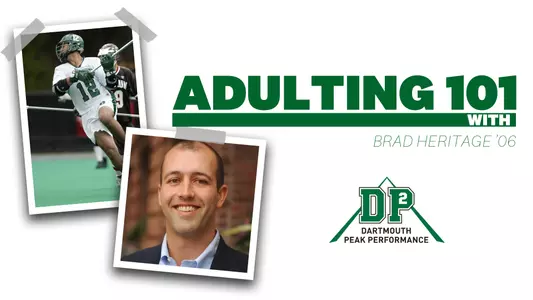
Brad Heritage ’06
PEAK Magazine Feature: Adulting 101 with Brad Heritage ’06
12/22/2020 9:44:00 AM | Men's Lacrosse, Peak Performance
Former men's lacrosse student-athlete presents ‘Making a Budget’ to current Big Green players.
From the Fall 2020 issue of PEAK Magazine, released in November.
So much time and energy are spent supporting student-athletes during their time at Dartmouth – academically, athletically and personally – with conviction and purpose. There is a strong sense that those individuals will be well prepared for life beyond Hanover. However, Associate Athletics Director Jen Chuks decided to offer an additional level of assurance and developed a new program called Adulting 101. The program title leaves little to the imagination and delivers practical, real-life lessons on a variety of important topics that are often left to chance.
"I thought this was a great opportunity to give our student-athletes exposure to skills that aren't necessarily taught in the classroom and help them understand how to prepare for life after Dartmouth," said Chuks. "In some ways, executing this program virtually gave us better access to alumni to deliver the content and it allowed us to dramatically expand the scope."
The initial idea was to produce 7-8 sessions across a variety of topics and cater it to seniors but the move to remote programming allowed access for all student-athletes.
Adulting 101 kicked off with a presentation from former lacrosse student-athlete Brad Heritage '06, one of several alumni who stepped forward to lend their knowledge and experience. His session — 'Making a Budget' — was one of the most popular and provided a great launch to the series.
"I'm always excited about any opportunity to engage with Dartmouth student-athletes, particularly when it involves helping them avoid some of the things that I 'stubbed my toe' on throughout my college career and life-to-date," said Heritage, whose wife, Eliza '10, played women's lacrosse for the Big Green. "Reflecting on my time at Dartmouth, I wish that I could've heard more from those that came before me about what they might have done differently."
Heritage's presentation offered a sweeping series of best practices addressing short-term and long-term strategies on topics such as tax brackets, the importance of building credit, selecting workplace benefits, managing debt and dealing with student loans.
"I wanted to convey that they shouldn't feel overwhelmed or intimidated by the topic or concepts being discussed, but that it's thoughtful to have a plan," added Heritage. "I've found that athletes often want to have a roadmap – or 'scouting report' if you will – of what lies ahead. But from there, they want the space, time, and freedom to prepare in a way that's authentic to them."
"That was the mindset that I tried to support with my presentation – giving the student-athletes a framework, along with some concepts to consider, but then letting them decide what would be most comfortable once empowered with that information. Everyone's relationship with money is uniquely personal, and I certainly don't have all the answers."
Additional programming included discussions around salary negotiation, retirement planning, investing, health insurance and preparing taxes – important lessons that are not always learned in college depending on an individual's course of study.
"I thought the program was effective and the student-athletes took away some really valuable information," said Chuks. "They were able to ask questions and hear from an expert in a particular field, someone who understands their environment and can relay important information that sets our student-athletes up for success after Dartmouth."
Chuks even admitted that she and her DP2 colleagues benefited from the experience.
"I had some of my own questions answered and learned things I didn't know," she added. "So it's clear we can all benefit from opportunities like these."
So much time and energy are spent supporting student-athletes during their time at Dartmouth – academically, athletically and personally – with conviction and purpose. There is a strong sense that those individuals will be well prepared for life beyond Hanover. However, Associate Athletics Director Jen Chuks decided to offer an additional level of assurance and developed a new program called Adulting 101. The program title leaves little to the imagination and delivers practical, real-life lessons on a variety of important topics that are often left to chance.
"I thought this was a great opportunity to give our student-athletes exposure to skills that aren't necessarily taught in the classroom and help them understand how to prepare for life after Dartmouth," said Chuks. "In some ways, executing this program virtually gave us better access to alumni to deliver the content and it allowed us to dramatically expand the scope."
The initial idea was to produce 7-8 sessions across a variety of topics and cater it to seniors but the move to remote programming allowed access for all student-athletes.
Adulting 101 kicked off with a presentation from former lacrosse student-athlete Brad Heritage '06, one of several alumni who stepped forward to lend their knowledge and experience. His session — 'Making a Budget' — was one of the most popular and provided a great launch to the series.
"I'm always excited about any opportunity to engage with Dartmouth student-athletes, particularly when it involves helping them avoid some of the things that I 'stubbed my toe' on throughout my college career and life-to-date," said Heritage, whose wife, Eliza '10, played women's lacrosse for the Big Green. "Reflecting on my time at Dartmouth, I wish that I could've heard more from those that came before me about what they might have done differently."
Heritage's presentation offered a sweeping series of best practices addressing short-term and long-term strategies on topics such as tax brackets, the importance of building credit, selecting workplace benefits, managing debt and dealing with student loans.
"I wanted to convey that they shouldn't feel overwhelmed or intimidated by the topic or concepts being discussed, but that it's thoughtful to have a plan," added Heritage. "I've found that athletes often want to have a roadmap – or 'scouting report' if you will – of what lies ahead. But from there, they want the space, time, and freedom to prepare in a way that's authentic to them."
"That was the mindset that I tried to support with my presentation – giving the student-athletes a framework, along with some concepts to consider, but then letting them decide what would be most comfortable once empowered with that information. Everyone's relationship with money is uniquely personal, and I certainly don't have all the answers."
Additional programming included discussions around salary negotiation, retirement planning, investing, health insurance and preparing taxes – important lessons that are not always learned in college depending on an individual's course of study.
"I thought the program was effective and the student-athletes took away some really valuable information," said Chuks. "They were able to ask questions and hear from an expert in a particular field, someone who understands their environment and can relay important information that sets our student-athletes up for success after Dartmouth."
Chuks even admitted that she and her DP2 colleagues benefited from the experience.
"I had some of my own questions answered and learned things I didn't know," she added. "So it's clear we can all benefit from opportunities like these."

2024 Dartmouth Athletics DRIVE Program
Friday, September 13
NCAA Diversity and Inclusion Social Media Campaign: Day 3
Sunday, October 22
NCAA Diversity and Inclusion Social Media Campaign: Day 2
Sunday, October 22
NCAA Diversity and Inclusion Social Media Campaign: Day 1
Sunday, October 22


