Big Green Learn, Grow and Connect at Black Student-Athlete Summit
7/14/2023 12:36:00 PM | Football, Women's Volleyball, Athletics, Peak Performance
Eight Dartmouth student-athletes traveled to the summit in late May
Every person is different. Every experience is unique.
Two very different people can go through something similar, like college, and have very different experiences. Yet, finding shared experiences is equally possible and can bring a sense of validation and belonging.
In late May, eight Dartmouth student-athletes (and three staff members) attended the Black Student-Athlete Summit in Los Angeles, California, which allowed them to connect to people who've had similar experiences.

Student-Athletes
Micah Green, Football
Nicole Ihensekhien, Women's Rugby
Jabari Johnson, Football
Bomi Ogunlari, Women's Volleyball
Victoria Page, Women's Basketball
Joey Richmond, Football
Izaiah Robinson, Men's Basketball
Perside Yolou, Women's Track and Field
Staff
Liz Johnson, DP2
Jabari Trotter, Men's Basketball
Pete Dawry, Sports Medicine
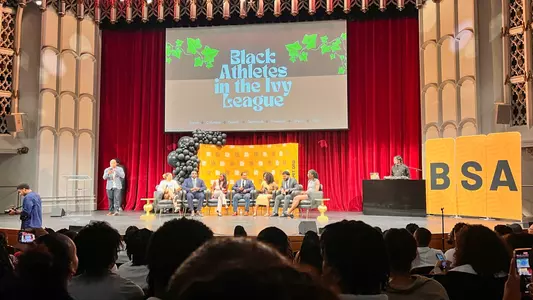
"The Black Student-Athlete Summit was an opportunity for us to see people who are like us and going through the same experiences we're going through," said Bomi Ogunlari of volleyball. "Throughout the summit, we went through different forums where people would speak. We even had our own Ivy League forum where we talked about what it's like to be a Black student-athlete in the Ivy League."
In the end, the forum served many purposes. It was an opportunity to learn, grow and connect.
Over the course of the three-day summit, there were more than a dozen forums, one of which was titled, "The Mental Health of Black Female Student-Athletes."
"Three University of South Carolina female student-athletes talked to us about the topic, and they were talking to people as a whole (not just Black women)," said Ogunlari. "It helped others see what Black women were going through."
The forum hit home for Ogunlari.
"We can feel isolated and there are a lot of hardships that we go through," she said. "I think we're often quieted because we don't want to make too much noise. We were really encouraged to speak out and seek help."
Breaking any stigma, or barrier, to seek help was a theme that often surfaced, including the first forum of the summit, titled "Black Student-Athletes in the Ivy League," featuring seven student-athletes from across the Ancient Eight, including Micah Green of Dartmouth football.

"One of our big topics was imposter syndrome and depression," he said.
One definition of imposter syndrome is the condition of feeling anxious and not experiencing success internally, despite being high-performing in external, objective ways.
The Ivy League student-athletes pointed to suicide rates, which in the Ivy League, are double the national average per 100,000 people.
"It's a pressure-induced environment where at every angle, you're expected to be at the top, academically and athletically," said Green.
That, coupled with being at a predominately white institution, adds to the overall pressure.
Another contributor is sense of community. At Dartmouth, student-athletes like Ogunlari and Green have community with the Dartmouth Black Student-Athlete Alliance (DBSAA), which was founded in 2020 and grew momentum in 2021 — when they began to receive funding from the college as a COSO (Council on Student Organizations) to support and hold events.
"It was a pivotal time," said Green. "That was when Black Lives Matter was the largest public movement in the United States."
Moving into this next academic year (2023-24), Green and Ogunlari will serve as presidents of the DBSAA.
"We're not just serving student-athletes," he said. "Yes, those are our target audiences, but we're also a community-building group."
The fact that the DBSAA is well-established at Dartmouth doesn't solve everything. But it helps create a community for Dartmouth student-athletes.
Many schools around the country aren't nearly as established.
"Especially for those schools where the affinity groups aren't well-recognized by the college or university, they barely see people who look like them in the administration or student body, so they can feel out of place talking about things such as microaggressions," said Green.
Microaggressions are verbal, behavioral or environmental slights that communicate hostile, derogatory, or negative attitudes toward stigmatized or culturally marginalized groups. They can be intentional or unintentional.
"Not being able to really talk to administration about microaggressions that you deal with, or even larger instances of racism, is an issue," said Green.
The environment at the Black Student-Athlete Summit was the exact opposite; it was a welcoming atmosphere, providing an opportunity to connect with so many others in meaningful ways.

"What stuck out to me about the summit was making so many connections with one another," said Ogunlari. "I met so many people and it opened my heart to be more welcoming and more understanding of where other people are coming from. I'm also more comfortable telling others my struggles and experiences with whatever is going on in my life — and being more vulnerable with one another.
"That helps you learn and grow as a person."
Speaking of learning and growing, Pro Day was a highlight of the summit. It featured a period of time when student-athletes registered for four different panels, each 30 minutes long.
"It was a networking opportunity to connect with panelists or companies that were right outside the building in a career fair type layout," said Green. "Some examples of the Pro Day panels were tech, graduate school, filmmaking, law, NIL in the context of shoe deals, Black professionalism (tattoos, jewelry, hair styles) and more."
The student-athletes were able to hear from a number of important people, including USC President, Dr. Carol Folt, who spoke at a forum. They also met Dr. Julie Rousseau, the Associate Athletic Director (Diversity, Equity & Inclusion at USC), as well as Dr. Leonard Moore and Dr. Ryan Sutton — the event founder and organizer, respectively.
"Meeting them was an awesome experience," said Green.
The forum also included speakers to help prepare the student-athletes for their futures.

"Former NBA player Matt Barnes spoke about his experience, explaining that money isn't everything, how to properly invest our money and how to properly take care of ourselves," said Ogunlari. "Each forum spoke to someone in the audience."
In the audience for the Big Green were eight student-athletes, by far the most Dartmouth Athletics has ever sent to the Black Student-Athlete Summit, which is growing at a national level.
"Last year, we were able to send two to Houston, Texas," said Ogunlari. "From last year to this year, the summit has grown by several hundred people. There were many returners from other schools, but we [from Dartmouth] were all first-timers."
The group of Big Green couldn't be more thankful.
"I'm genuinely really grateful for this opportunity and being able to go," said Ogunlari. "It's an invaluable experience that you can't really get anywhere else. We can talk to alums or reach out to other Ivy League student-athletes who look like us, but this provided such a broader experience that we can't get in Hanover, New Hampshire.
"I took so much from it," she continued. "I wish I could go again."
Two very different people can go through something similar, like college, and have very different experiences. Yet, finding shared experiences is equally possible and can bring a sense of validation and belonging.
In late May, eight Dartmouth student-athletes (and three staff members) attended the Black Student-Athlete Summit in Los Angeles, California, which allowed them to connect to people who've had similar experiences.
Student-Athletes
Micah Green, Football
Nicole Ihensekhien, Women's Rugby
Jabari Johnson, Football
Bomi Ogunlari, Women's Volleyball
Victoria Page, Women's Basketball
Joey Richmond, Football
Izaiah Robinson, Men's Basketball
Perside Yolou, Women's Track and Field
Staff
Liz Johnson, DP2
Jabari Trotter, Men's Basketball
Pete Dawry, Sports Medicine
"The Black Student-Athlete Summit was an opportunity for us to see people who are like us and going through the same experiences we're going through," said Bomi Ogunlari of volleyball. "Throughout the summit, we went through different forums where people would speak. We even had our own Ivy League forum where we talked about what it's like to be a Black student-athlete in the Ivy League."
In the end, the forum served many purposes. It was an opportunity to learn, grow and connect.
Over the course of the three-day summit, there were more than a dozen forums, one of which was titled, "The Mental Health of Black Female Student-Athletes."
"Three University of South Carolina female student-athletes talked to us about the topic, and they were talking to people as a whole (not just Black women)," said Ogunlari. "It helped others see what Black women were going through."
The forum hit home for Ogunlari.
"We can feel isolated and there are a lot of hardships that we go through," she said. "I think we're often quieted because we don't want to make too much noise. We were really encouraged to speak out and seek help."
Breaking any stigma, or barrier, to seek help was a theme that often surfaced, including the first forum of the summit, titled "Black Student-Athletes in the Ivy League," featuring seven student-athletes from across the Ancient Eight, including Micah Green of Dartmouth football.
"One of our big topics was imposter syndrome and depression," he said.
One definition of imposter syndrome is the condition of feeling anxious and not experiencing success internally, despite being high-performing in external, objective ways.
The Ivy League student-athletes pointed to suicide rates, which in the Ivy League, are double the national average per 100,000 people.
"It's a pressure-induced environment where at every angle, you're expected to be at the top, academically and athletically," said Green.
That, coupled with being at a predominately white institution, adds to the overall pressure.
Another contributor is sense of community. At Dartmouth, student-athletes like Ogunlari and Green have community with the Dartmouth Black Student-Athlete Alliance (DBSAA), which was founded in 2020 and grew momentum in 2021 — when they began to receive funding from the college as a COSO (Council on Student Organizations) to support and hold events.
"It was a pivotal time," said Green. "That was when Black Lives Matter was the largest public movement in the United States."
Moving into this next academic year (2023-24), Green and Ogunlari will serve as presidents of the DBSAA.
"We're not just serving student-athletes," he said. "Yes, those are our target audiences, but we're also a community-building group."
The fact that the DBSAA is well-established at Dartmouth doesn't solve everything. But it helps create a community for Dartmouth student-athletes.
Many schools around the country aren't nearly as established.
"Especially for those schools where the affinity groups aren't well-recognized by the college or university, they barely see people who look like them in the administration or student body, so they can feel out of place talking about things such as microaggressions," said Green.
Microaggressions are verbal, behavioral or environmental slights that communicate hostile, derogatory, or negative attitudes toward stigmatized or culturally marginalized groups. They can be intentional or unintentional.
"Not being able to really talk to administration about microaggressions that you deal with, or even larger instances of racism, is an issue," said Green.
The environment at the Black Student-Athlete Summit was the exact opposite; it was a welcoming atmosphere, providing an opportunity to connect with so many others in meaningful ways.
"What stuck out to me about the summit was making so many connections with one another," said Ogunlari. "I met so many people and it opened my heart to be more welcoming and more understanding of where other people are coming from. I'm also more comfortable telling others my struggles and experiences with whatever is going on in my life — and being more vulnerable with one another.
"That helps you learn and grow as a person."
Speaking of learning and growing, Pro Day was a highlight of the summit. It featured a period of time when student-athletes registered for four different panels, each 30 minutes long.
"It was a networking opportunity to connect with panelists or companies that were right outside the building in a career fair type layout," said Green. "Some examples of the Pro Day panels were tech, graduate school, filmmaking, law, NIL in the context of shoe deals, Black professionalism (tattoos, jewelry, hair styles) and more."
The student-athletes were able to hear from a number of important people, including USC President, Dr. Carol Folt, who spoke at a forum. They also met Dr. Julie Rousseau, the Associate Athletic Director (Diversity, Equity & Inclusion at USC), as well as Dr. Leonard Moore and Dr. Ryan Sutton — the event founder and organizer, respectively.
"Meeting them was an awesome experience," said Green.
The forum also included speakers to help prepare the student-athletes for their futures.
"Former NBA player Matt Barnes spoke about his experience, explaining that money isn't everything, how to properly invest our money and how to properly take care of ourselves," said Ogunlari. "Each forum spoke to someone in the audience."
In the audience for the Big Green were eight student-athletes, by far the most Dartmouth Athletics has ever sent to the Black Student-Athlete Summit, which is growing at a national level.
"Last year, we were able to send two to Houston, Texas," said Ogunlari. "From last year to this year, the summit has grown by several hundred people. There were many returners from other schools, but we [from Dartmouth] were all first-timers."
The group of Big Green couldn't be more thankful.
"I'm genuinely really grateful for this opportunity and being able to go," said Ogunlari. "It's an invaluable experience that you can't really get anywhere else. We can talk to alums or reach out to other Ivy League student-athletes who look like us, but this provided such a broader experience that we can't get in Hanover, New Hampshire.
"I took so much from it," she continued. "I wish I could go again."
Players Mentioned
LB
/ Football
DE
/ Football
MB/RS
/ Women's Volleyball
RB
/ FootballSunday, September 27
Sunday, September 27
Saturday, September 26
Saturday, September 26