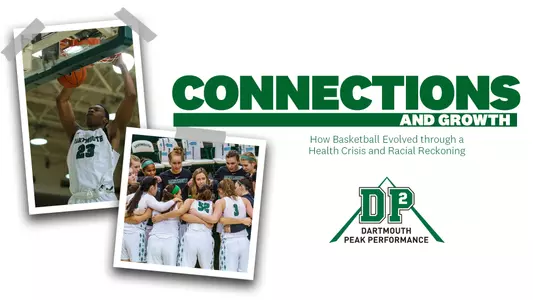
PEAK Magazine Feature: Connection and Growth
12/30/2020 1:34:00 PM | Men's Basketball, Women's Basketball, Peak Performance
How Basketball Evolved through a Health Crisis and Racial Reckoning.
Katie Douglas '22 was in high school at New Jersey's prestigious Blair Academy when she decided to pursue an Ivy League education. She was intrigued by the opportunity to earn a world-class education while also making valuable connections that she would cherish for the rest of her life, and because of basketball, the 5-foot 8-inch junior guard was able to do just that. But it wasn't just the women's hoops team and the coaching staff that brought Douglas to Dartmouth. On her recruitment visit, Douglas met administrators from Dartmouth's Peak Performance program (known colloquially as DP2) and was introduced to the full spectrum of student-athlete support offered by the school. "I was really impressed," Douglas says. "There are so many categories of help that you can get, and I think it is one-of-a-kind to Dartmouth."
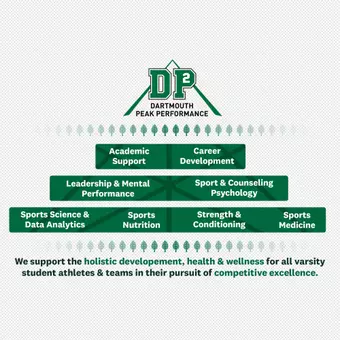
Indeed, while other schools may limit their offerings to academic assistance, physical training, and nutritional guidance, Dartmouth's DP2 takes a fully holistic approach to student-athlete care. In addition to the aforementioned areas of support, DP2 also offers sport counseling and psychology; leadership and mental performance training; and unparalleled, Ivy League-driven career development services.
The goal of DP2 is, of course, to help Douglas and others adjust to campus life as both students and athletes, to enable them to exceed both in and out of sports, now and in the future. This a lofty endeavor even in the best of circumstances, as student-athletes couple the concerns common to all college students with the pressures and time commitments of Division-I competition.
But when you add in a globe-sweeping pandemic that triggered worldwide shutdowns and completely upended life as we know it, the work of DP2 and Dartmouth Athletics' coaches takes on a whole new level of importance and urgency.
"When the pandemic hit and our country started shutting down, the first question we had for our coaching staff was, 'How are we going to create a normal and find a certainty for our team?'" says Belle Koclanes, Gail Koziara Boudreaux '82 and Family Head Coach of Women's Basketball.
With the last game of the season and the annual banquet behind them, normal would have actually been relatively similar to life in the era of COVID. Coach Belle's staff typically only meets with the players as a group during the fall and winter terms; by spring term and the end of the season, the players head off for internships, studies abroad, and other opportunities, forcing the coaches to turn to technology to keep everyone connected.
"In past we would use Facebook in spring and summer," Coach Belle says, "but this year, with everything going on, we wanted to do more. We've been meeting on Zoom twice a week, but we needed a place to connect, share and organize ideas between team talks."
The solution was Milanote, a virtual platform designed to help creatives organize and collaborate on new projects. The app's "infinite virtual canvas" allows writers, artists, and designers to easily drop in images, video, text, and other materials for each stage of the creative process, but Belle saw the boards as the ideal vehicle for gathering all of the resources needed to keep her team in synch. Coaches populated pages with drills, film clips, inspirational quotes, and more, and players were given edit access, too, thus allowing for free-flowing communication and collaboration between players and coaches.
"[Milanote] was just a nice platform that you could go to at any time and post whatever you want," says Douglas. "It was something to look forward to as we were all away from each other and just a good way to stay connected."
Meanwhile, as the women's team gathered for the team huddles on Milanote, the men's team began hosting their own meetings on Zoom. Like Coach Belle, men's head coach David McLaughlin, saw the meetings as more than just an opportunity to discuss skills training or other basketball topics. For Coach McLaughlin, it was also a way to bring some sense of ordinary to a world that had turned bizarre overnight.
"With Zoom, we always knew there was a home base and a time where we could get together as a team," he says. "Doing that helped us get back into a little bit of a routine."
There may have been routine, but there was no formal agenda ascribed to these meetings, at least not in the earliest days of the pandemic. Instead, they followed a fluid format that left space for much needed updates related to COVID-19 and the reopening of campus, as well as team-specific messaging. Student-athletes were looking to their coaches for answers, and when the coaches lacked the necessary information, they were turning to DP2 for guidance.
"DP2 wanted to be sure to provide quality information without adding to the infodemic," says Lyndsay Ostler, Assistant Athletics Director for DP2/Academics. "With all of their classes online, it was easy for student-athlete inboxes to be flooded; therefore, we committed to streamlining information into a weekly digest of DP2 Updates. Every Sunday, all student-athletes and coaches got a list of activities, resources, and timely information from all of the DP2 services areas in their inbox so they have a one-stop shop for all things Peak Performance."
Coach McLaughlin believes that these efforts of the DP2 staff helped to minimize the anxiety and uncertainty that could have overtaken his players at the beginning of the shutdown, noting, "Ian and his team did a phenomenal job of making sure the resources were there so our athletes were still developing in all areas. Strength and conditioning, mental training, internships—they provided the support that allowed us to continue to grow across the board."
Months later, Douglas admits that she did feel quite overwhelmed in March and April, that, really, "it was kind of hard for people to not be overwhelmed, honestly." But with the benefit of hindsight as well as conversations with student-athlete friends from other universities, she's also gained a greater appreciation for DP2's pandemic support.
"They did a great job," Douglas says. "They supported us in every way they could and asked us to send questions to see if they could find the answers. I think they were really responsive and were definitely on our side. We knew someone cared about us in that department, so that was great."
Chris Knight '21, a 6-foot, 7-inch forward for the men's team, agrees. Not only did DP2 help ease the burden that bore down on him once his mother lost her job because of the shutdowns, but he was also able to participate in a leadership training lab. "They were really supportive," Knight says of DP2 staff, "and they definitely tried to create opportunities so that people could continue to learn and get better while they were still at home."
If the physical separation triggered by a global health crisis had been the extent of the concerns—both for Dartmouth's student-athletes and our country at large—Zoom and Milanote could have likely provided all the solution necessary. Dartmouth's teams would have continued to meet and talk and train virtually, all the while washing their hands and wearing their masks. And eventually—hopefully—life as we once knew it would resume.
But as it turned out, an airborne virus wasn't our nation's only sickness. On May 5—long after grocery store shelves had been stripped clean of essential items and essential workers found themselves stripped of their ability to keep themselves healthy—a video depicting the vicious shooting of a Black jogger by a white man in a pickup truck began slashing through the internet.
In the most tragic of circumstances, Ahmaud Arbery's death would be but the first in a string of killings that would shine a harsh light on this country's deepest divisions. And with national coverage of the deaths of George Floyd and Breonna Taylor, courtesy of the Minneapolis and Louisville Police Departments, respectively, the threat of the coronavirus seemed almost secondary to the assurance of racial injustice.
—
As it had been for Douglas, Knight's decision to attend Dartmouth College was an easy one. He says that Coach McLaughlin made him feel like a priority during the recruiting process, coming to many of his AAU games, calling him regularly, and going out of his way to make him feel that he "would always be cared for."
Ultimately, though, it was the prodding of Knight's father, a Jamaican immigrant who understood the value of an Ivy League education, as well as Knight's own desire to take advantage of the accompanying social networking opportunities that crystalized Knight's choice. Basketball had opened the door to many other schools as well, but Knight knew that he couldn't pass up Dartmouth—even if the shift in culture from the streets of New York to the forests of New Hampshire threatened to traumatize as much as it shocked.
Regarding the adjustment to life on a predominately white campus during his first three years at Dartmouth, Knight says that he learned how to navigate on his own. "You kind of have to avoid certain topics," he explains. "You just kinda reaffirm [white people's] beliefs and stay away from your heavy, controversial beliefs, and you'll be fine."
It was a necessary approach for Knight, as he admits to being subjected to countless microagressions and walking into rooms where he could "feel the racism." Without anyone to talk to about these issues—even Coach McLaughlin—Knight's approach was also a calculated act of self-preservation. "What some Black students do when they can't talk about these things is just internalize it and talk about it amongst themselves," Knight says. "They're scared to talk about it with their coach or anyone of authority."
All of that changed, however, as every corner of American society began to face its own racial reckoning. Marchers took to the streets in cities from Seattle, Washington, to Washington, D.C., and, all at once, Dartmouth coaches and DP2 staffers were forced to address the inequities and insensitivities in their own backyard.
"I needed to be able to support everyone [on the team]," says Coach McLaughlin, "and this wasn't something that we'd spent enough time on. I thought about some of the older guys on the team, and I thought that I should have had these conversations with them when they were first-year students. I didn't, and in some ways I failed them, but we're not going to do that anymore."
Knight notes that the early discussions were awkward, that no one really knew how best to broach the conversations that had been ignored for so long. Then, when the talking did start, it was often interrupted by silences that were louder than any individual's voice.
"As a coach we're always giving answers and explaining how to do things, but this needed to be more organic," Coach McLaughlin says. "Sometimes the silence was only 10 seconds, but it felt like 10 minutes, and we had to understand that if no one says anything it's okay. There doesn't have to be an answer right now, and as long as we stay consistent with it, maybe there's more discussion down the road."
To help guide those discussions in a way that would effectively address the newest normal of both pandemic and protest, the men's basketball team was given assigned reading: White Fragility by Robin DiAngelo. The book topped bestsellers lists in late spring and early summer as people clamored for insight into America's long-festering racial wounds, and while Knight agrees that the book was clearly written for white people who been relatively blind to the pervasiveness of white supremacy, he found it helpful nonetheless.
"We started talking about the book, but we always diverged from that," he says. "I think the book was just there for a foundation because white people don't necessarily know how to start these conversations. So I didn't mind reading the book because I feel like it gave us a starting point and a place to start to talk about our families."
During the ensuing weeks and months, as conversations and demonstrations alike continued, Knight says he received periodic texts from his teammates asking how he was holding up. He believes this occurrence is likely because the other men's basketball players are also young and used to playing a sport that, at its highest levels, is dominated by Black athletes. But the older members of the coaching staff were less likely to have spent significant time around Black people and, thus, needed a bit more time to reach a point of comfortability in talking about race. Still, Knight is grateful for the progress, despite the ongoing process.
"I definitely think that if I have a problem right now about race, I will message my coach and talk to him about it, which I didn't feel I could do my freshman year," Knight says. "I think that's very important. You need to have a support network, especially in spaces where you don't feel like the space was made for you."
At the same time, while the men's team was solidifying its newly built support system, the women's team was adapting their twice-weekly conversations to go much deeper than sport. Each player engaged in their own research on issues like police brutality before unpacking it all during team meetings. And through it all, as eyes were opened and uncomfortable topics raised, the women challenged each other to grow together. "Having community conversations to keep us informed on the present state of the world and our country was one of the most important aspects we had through this website [Milanote]," explained Douglas, who is confident that she is now a better friend and ally for her Black teammates as a result of their collective efforts.
"At the beginning of this," says Harry Sheehy, Dartmouth's Director of Athletics and Recreation, "I turned to Ian and our DP2 Staff and said, 'We have to find a way to stay connected to these young men and women.' And they have exceeded my expectations every step of the way. They were able to transition all the amazing in-person services our student-athletes have become accustomed to into virtual programming, Zoom sessions, and use of technology I had never heard of a year ago. Across DP2 and our coaching staffs, one of the things that has impressed me most has been their intentionality. Whether it's discussions of social justice or decisions to use one kind of technology over another, it is clear that there has been such thought put into the decisions that will best serve our student-athletes."
Indeed, as 2020 comes to a close, this intentionality has brought a level of growth and maturation to all members of Dartmouth's athletic program. This year has had its challenges, to be sure, but players, coaches, and DP2 staffers all believe that those challenges have been productive.
"The role that all of us play in supporting student-athlete mental health, creating inclusive cultures, and fighting hate and oppression has never been more salient," says Ian Connole, Senior Associate Athletics Director for Peak Performance. "We've used this moment to build long-term practices, learning opportunities, and service offerings that will continue well after sports return to a greater sense of normality. Listening to our student-athletes and partnering with them to make a positive impact in our communities has really pushed us all to grow and evolve to meet their needs."
Andrea Williams is the author of the forthcoming Baseball's Leading Lady: Effa Manley and The Rise and Fall of the Negro Leagues.
Indeed, while other schools may limit their offerings to academic assistance, physical training, and nutritional guidance, Dartmouth's DP2 takes a fully holistic approach to student-athlete care. In addition to the aforementioned areas of support, DP2 also offers sport counseling and psychology; leadership and mental performance training; and unparalleled, Ivy League-driven career development services.
The goal of DP2 is, of course, to help Douglas and others adjust to campus life as both students and athletes, to enable them to exceed both in and out of sports, now and in the future. This a lofty endeavor even in the best of circumstances, as student-athletes couple the concerns common to all college students with the pressures and time commitments of Division-I competition.
But when you add in a globe-sweeping pandemic that triggered worldwide shutdowns and completely upended life as we know it, the work of DP2 and Dartmouth Athletics' coaches takes on a whole new level of importance and urgency.
—
"When the pandemic hit and our country started shutting down, the first question we had for our coaching staff was, 'How are we going to create a normal and find a certainty for our team?'" says Belle Koclanes, Gail Koziara Boudreaux '82 and Family Head Coach of Women's Basketball.
With the last game of the season and the annual banquet behind them, normal would have actually been relatively similar to life in the era of COVID. Coach Belle's staff typically only meets with the players as a group during the fall and winter terms; by spring term and the end of the season, the players head off for internships, studies abroad, and other opportunities, forcing the coaches to turn to technology to keep everyone connected.
"In past we would use Facebook in spring and summer," Coach Belle says, "but this year, with everything going on, we wanted to do more. We've been meeting on Zoom twice a week, but we needed a place to connect, share and organize ideas between team talks."
The solution was Milanote, a virtual platform designed to help creatives organize and collaborate on new projects. The app's "infinite virtual canvas" allows writers, artists, and designers to easily drop in images, video, text, and other materials for each stage of the creative process, but Belle saw the boards as the ideal vehicle for gathering all of the resources needed to keep her team in synch. Coaches populated pages with drills, film clips, inspirational quotes, and more, and players were given edit access, too, thus allowing for free-flowing communication and collaboration between players and coaches.
"[Milanote] was just a nice platform that you could go to at any time and post whatever you want," says Douglas. "It was something to look forward to as we were all away from each other and just a good way to stay connected."
Meanwhile, as the women's team gathered for the team huddles on Milanote, the men's team began hosting their own meetings on Zoom. Like Coach Belle, men's head coach David McLaughlin, saw the meetings as more than just an opportunity to discuss skills training or other basketball topics. For Coach McLaughlin, it was also a way to bring some sense of ordinary to a world that had turned bizarre overnight.
"With Zoom, we always knew there was a home base and a time where we could get together as a team," he says. "Doing that helped us get back into a little bit of a routine."
There may have been routine, but there was no formal agenda ascribed to these meetings, at least not in the earliest days of the pandemic. Instead, they followed a fluid format that left space for much needed updates related to COVID-19 and the reopening of campus, as well as team-specific messaging. Student-athletes were looking to their coaches for answers, and when the coaches lacked the necessary information, they were turning to DP2 for guidance.
"DP2 wanted to be sure to provide quality information without adding to the infodemic," says Lyndsay Ostler, Assistant Athletics Director for DP2/Academics. "With all of their classes online, it was easy for student-athlete inboxes to be flooded; therefore, we committed to streamlining information into a weekly digest of DP2 Updates. Every Sunday, all student-athletes and coaches got a list of activities, resources, and timely information from all of the DP2 services areas in their inbox so they have a one-stop shop for all things Peak Performance."
Coach McLaughlin believes that these efforts of the DP2 staff helped to minimize the anxiety and uncertainty that could have overtaken his players at the beginning of the shutdown, noting, "Ian and his team did a phenomenal job of making sure the resources were there so our athletes were still developing in all areas. Strength and conditioning, mental training, internships—they provided the support that allowed us to continue to grow across the board."
Months later, Douglas admits that she did feel quite overwhelmed in March and April, that, really, "it was kind of hard for people to not be overwhelmed, honestly." But with the benefit of hindsight as well as conversations with student-athlete friends from other universities, she's also gained a greater appreciation for DP2's pandemic support.
"They did a great job," Douglas says. "They supported us in every way they could and asked us to send questions to see if they could find the answers. I think they were really responsive and were definitely on our side. We knew someone cared about us in that department, so that was great."
Chris Knight '21, a 6-foot, 7-inch forward for the men's team, agrees. Not only did DP2 help ease the burden that bore down on him once his mother lost her job because of the shutdowns, but he was also able to participate in a leadership training lab. "They were really supportive," Knight says of DP2 staff, "and they definitely tried to create opportunities so that people could continue to learn and get better while they were still at home."
If the physical separation triggered by a global health crisis had been the extent of the concerns—both for Dartmouth's student-athletes and our country at large—Zoom and Milanote could have likely provided all the solution necessary. Dartmouth's teams would have continued to meet and talk and train virtually, all the while washing their hands and wearing their masks. And eventually—hopefully—life as we once knew it would resume.
But as it turned out, an airborne virus wasn't our nation's only sickness. On May 5—long after grocery store shelves had been stripped clean of essential items and essential workers found themselves stripped of their ability to keep themselves healthy—a video depicting the vicious shooting of a Black jogger by a white man in a pickup truck began slashing through the internet.
In the most tragic of circumstances, Ahmaud Arbery's death would be but the first in a string of killings that would shine a harsh light on this country's deepest divisions. And with national coverage of the deaths of George Floyd and Breonna Taylor, courtesy of the Minneapolis and Louisville Police Departments, respectively, the threat of the coronavirus seemed almost secondary to the assurance of racial injustice.
—
As it had been for Douglas, Knight's decision to attend Dartmouth College was an easy one. He says that Coach McLaughlin made him feel like a priority during the recruiting process, coming to many of his AAU games, calling him regularly, and going out of his way to make him feel that he "would always be cared for."
Ultimately, though, it was the prodding of Knight's father, a Jamaican immigrant who understood the value of an Ivy League education, as well as Knight's own desire to take advantage of the accompanying social networking opportunities that crystalized Knight's choice. Basketball had opened the door to many other schools as well, but Knight knew that he couldn't pass up Dartmouth—even if the shift in culture from the streets of New York to the forests of New Hampshire threatened to traumatize as much as it shocked.
Regarding the adjustment to life on a predominately white campus during his first three years at Dartmouth, Knight says that he learned how to navigate on his own. "You kind of have to avoid certain topics," he explains. "You just kinda reaffirm [white people's] beliefs and stay away from your heavy, controversial beliefs, and you'll be fine."
It was a necessary approach for Knight, as he admits to being subjected to countless microagressions and walking into rooms where he could "feel the racism." Without anyone to talk to about these issues—even Coach McLaughlin—Knight's approach was also a calculated act of self-preservation. "What some Black students do when they can't talk about these things is just internalize it and talk about it amongst themselves," Knight says. "They're scared to talk about it with their coach or anyone of authority."
All of that changed, however, as every corner of American society began to face its own racial reckoning. Marchers took to the streets in cities from Seattle, Washington, to Washington, D.C., and, all at once, Dartmouth coaches and DP2 staffers were forced to address the inequities and insensitivities in their own backyard.
"I needed to be able to support everyone [on the team]," says Coach McLaughlin, "and this wasn't something that we'd spent enough time on. I thought about some of the older guys on the team, and I thought that I should have had these conversations with them when they were first-year students. I didn't, and in some ways I failed them, but we're not going to do that anymore."
Knight notes that the early discussions were awkward, that no one really knew how best to broach the conversations that had been ignored for so long. Then, when the talking did start, it was often interrupted by silences that were louder than any individual's voice.
"As a coach we're always giving answers and explaining how to do things, but this needed to be more organic," Coach McLaughlin says. "Sometimes the silence was only 10 seconds, but it felt like 10 minutes, and we had to understand that if no one says anything it's okay. There doesn't have to be an answer right now, and as long as we stay consistent with it, maybe there's more discussion down the road."
To help guide those discussions in a way that would effectively address the newest normal of both pandemic and protest, the men's basketball team was given assigned reading: White Fragility by Robin DiAngelo. The book topped bestsellers lists in late spring and early summer as people clamored for insight into America's long-festering racial wounds, and while Knight agrees that the book was clearly written for white people who been relatively blind to the pervasiveness of white supremacy, he found it helpful nonetheless.
"We started talking about the book, but we always diverged from that," he says. "I think the book was just there for a foundation because white people don't necessarily know how to start these conversations. So I didn't mind reading the book because I feel like it gave us a starting point and a place to start to talk about our families."
During the ensuing weeks and months, as conversations and demonstrations alike continued, Knight says he received periodic texts from his teammates asking how he was holding up. He believes this occurrence is likely because the other men's basketball players are also young and used to playing a sport that, at its highest levels, is dominated by Black athletes. But the older members of the coaching staff were less likely to have spent significant time around Black people and, thus, needed a bit more time to reach a point of comfortability in talking about race. Still, Knight is grateful for the progress, despite the ongoing process.
"I definitely think that if I have a problem right now about race, I will message my coach and talk to him about it, which I didn't feel I could do my freshman year," Knight says. "I think that's very important. You need to have a support network, especially in spaces where you don't feel like the space was made for you."
At the same time, while the men's team was solidifying its newly built support system, the women's team was adapting their twice-weekly conversations to go much deeper than sport. Each player engaged in their own research on issues like police brutality before unpacking it all during team meetings. And through it all, as eyes were opened and uncomfortable topics raised, the women challenged each other to grow together. "Having community conversations to keep us informed on the present state of the world and our country was one of the most important aspects we had through this website [Milanote]," explained Douglas, who is confident that she is now a better friend and ally for her Black teammates as a result of their collective efforts.
—
If it is true that we are tested not to show our weaknesses, but to discover our strengths, 2020 has been poised to unearth the courage and resilience lying dormant within us in a way we haven't seen in an entire generation. For Dartmouth's student-athletes, this year has presented an opportunity to find their voices and make them heard, to lay down their own bodies to bridge the widening gulfs between us. And for DP2 and Dartmouth's coaching staffs, 2020 has been a year of refining and defining, of executing on the program's mission to demonstrate inclusive excellence and provide collaborative support like never before."At the beginning of this," says Harry Sheehy, Dartmouth's Director of Athletics and Recreation, "I turned to Ian and our DP2 Staff and said, 'We have to find a way to stay connected to these young men and women.' And they have exceeded my expectations every step of the way. They were able to transition all the amazing in-person services our student-athletes have become accustomed to into virtual programming, Zoom sessions, and use of technology I had never heard of a year ago. Across DP2 and our coaching staffs, one of the things that has impressed me most has been their intentionality. Whether it's discussions of social justice or decisions to use one kind of technology over another, it is clear that there has been such thought put into the decisions that will best serve our student-athletes."
Indeed, as 2020 comes to a close, this intentionality has brought a level of growth and maturation to all members of Dartmouth's athletic program. This year has had its challenges, to be sure, but players, coaches, and DP2 staffers all believe that those challenges have been productive.
"The role that all of us play in supporting student-athlete mental health, creating inclusive cultures, and fighting hate and oppression has never been more salient," says Ian Connole, Senior Associate Athletics Director for Peak Performance. "We've used this moment to build long-term practices, learning opportunities, and service offerings that will continue well after sports return to a greater sense of normality. Listening to our student-athletes and partnering with them to make a positive impact in our communities has really pushed us all to grow and evolve to meet their needs."
Andrea Williams is the author of the forthcoming Baseball's Leading Lady: Effa Manley and The Rise and Fall of the Negro Leagues.
Players Mentioned

G
/ Women's Basketball
F
/ Men's BasketballFriday, September 13
Sunday, October 22
Sunday, October 22
Sunday, October 22