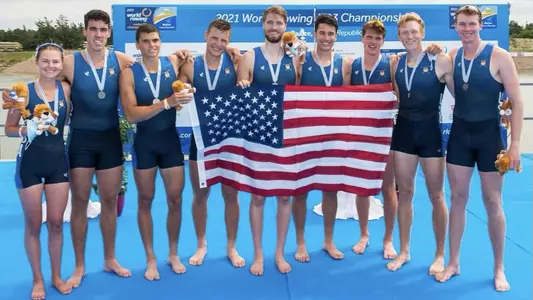
Normally, the starting line of a race presents Dartmouth athletes with a chance to test their skills among other student-athletes across the United States. But for
William Bender '24 and
Jacob Hudgins '23, who represented the USA in the men's eight at the World Under 23 Rowing Championships in Racice, Czech Republic, the starting line included teams representing countries on the world stage.
The men's eight was one of many U.S. boats that raced other countries at the World Under 23 Rowing Championships. The regatta took place from July 7-11 and consisted of two initial heats, two repechages, and an A and B final. The men's eight placed second, receiving a silver medal with a time of 05:34.55, less than a quarter of a second behind the Great Britain gold medal time of 05:34.34.
"We knew it would be a hard race," said Bender. "We were close to the Brits' time in the semis and we knew that would be the case in the final."
Rowers interested in competing in a bigger boat (such as the eight and the four) were asked to submit Concept2 — also known as the erg— times and previous racing experience to the Under 23 Selection Camp. The camp takes place for about six weeks prior to the regatta and several cuts are made before the lineups are finalized. Smaller boats consisted of first-place finishers at the USRowing U23 Trials.
Both Bender and Hudgins were grateful for the opportunity to represent the U.S. on the national stage and aren't willing to stop at second place. The race only served to further their passion for the sport and their desire to win.
"In terms of the actual race itself, I probably takeaway most that we lost," said Hudgins. "And that's disappointing but I would say It's the process for me that matters most. At the end of the day, I have a lot more rowing to do in my life. I want to keep it in perspective and say that was a good process-oriented training cycle for me."
While this was Bender's and Hudgins' first time on the U23 team, Hudgins had previously represented the U.S. internationally as part of the U19 team before coming to Dartmouth. Going into camp, he had a simple yet formidable task.
"My goal going into the camp was to make the team and win," Hudgins said. "In past years, there were a lot of guys that were pretty big on the erg and had already done the U23 team. This year was kind of a clean slate. We only had a few guys who had done the U23 team before. We wanted to see what we could do on the international stage."
Unlike Hudgins, Bender did not have any national team experience before making the U23 team this year. He took a gap year before starting at Dartmouth, however, and during that time
he trained at the Thames Rowing Club in London, England.
"That was a great experience," said Bender. "I got a lot faster and was able to just focus on rowing. Clubs in the U.K. are all adults, so that forced me to grow up a little bit before coming to college."
Bender decided to apply to the selection camp because he wanted to take his rowing to a new level. He was confident after a successful spring at Dartmouth that he would be a contender for a spot.
"I had the time, so I submitted an application," remarked Bender. "I thought I might be invited but I didn't know. You always want to aim high. My goal was to make the eight which is the top boat. At Dartmouth, we had a really strong spring, so that gave me a lot of confidence going into the camp."
Bender and Hudgins found training with the U23 team to be impactful and full of learning experiences. The training was certainly demanding but rewarding in its own right.
"We did double practices almost every day," said Hudgins. "We took one day off in the month that we trained. Just a lot of rowing and a lot of volume. Probably the most I've done. We were doing race pace, hard pieces and hard workouts until like two days before racing started."
Selection camp was a memorable experience for Bender as well. The camp brought together rowers from competing schools across the U.S. and united them under one goal:
to perform at a high level on the international stage.
"Selection camp is different than the team at Dartmouth," said Bender. "The dynamic is different because we are all from competing programs. At Dartmouth, you show up because you are making boats go fast with your friends and classmates, which is just different. However, it was valuable having guys to look up to, and there are things I can learn from them."
The camaraderie that comes from rowing with your close friends, classmates and people that you are around all the time is difficult to duplicate for only a few months during the summer. The long training sessions and desire to win, however, does serve to bring rowers closer. It helped both Bender and Hudgins that Dartmouth was well represented at the U23 selection camp.
"Dartmouth was the only school that had two guys in the eight," said Bender. "It was really nice. We were friends already and selection camp brought us closer. It's nice to have someone you can talk with about experience."
As a rower, it is imperative to know that your teammates have your back. Every member of the boat must be willing to put everything else aside that might be occupying mental space for 2,000 meters to focus solely on making the boat go fast.
"Being with all
8 eight of those other people in the boat, the vibe in the boat was pretty soft spoken," Hudgins recalled. "There were no personalities that tried to dominate the rhythm. We all synched up really well right away. It was easy to row in that boat with guys you know had your back every step of the way. It was a special boat. There was no one who tried to dominate the rhythm."
The rhythm and speed that the boat gained during their time training in the weeks before the U23 regatta gave both Bender and Hudgins confidence approaching their initial heat, which took place on July 8 during the early stages of the regatta.
"When we won the heat, we kind of just thought, okay, we did what we were supposed to do and now on to the final," said Bender. "In terms of the final, we hoped to take luck out of it. The goal is that when you sit on the start line, if you have a good piece, you will win."
With such a close finish in the final, Bender and Hudgins had mixed emotions. While they were extremely grateful for the chance to represent the U.S. on the international level and to win a silver medal, they were left with the feeling that a gold medal was within reach and the boat fell just tenths of a second short.
"I remember getting walked through in the last 100 meters," said Bender. "I don't like losing. That's what sticks with me. Especially a close second, I was just thinking where we, as a boat, could have found two tenths of a second."
Hudgins recalled a similar sentiment to Bender about preparing for the final and the boat's placement in the final race.
"The final was a crazy race but going into it, we thought that if we rowed our own race and did what we are capable of doing, we could come away with a W," said Hudgins. "That didn't happen and that's disappointing, but we wanted to just row our own race, be in our rhythm and be confident in it."
Hudgins also recalled the most memorable aspect of the race for him was the amount of pain rowers must endure in order to be competitive on the international stage.
"The thing I remember most is how much pain I was in," Hudgins recalled. "I have never been in that amount of pain before. I have never seen that many people in that much pain after a race. It was so close all the way down between four boats that everyone was selling their souls to win. When you are seat for seat with three other boats, you are absolutely selling your soul."
While both Bender and Hudgins recalled the disappointment of missing the gold medal by inches, both found they learned valuable lessons from the experience, and it only served to increase their desire to continue training hard and racing with hopes of returning to the world stage to compete again.
"The goal is to use the memory of this race, and experience, to train harder," Bender said. "Next time you don't want to get up to do that extra workout or you don't want to do those extra two 500s, you remember this is tough. But losing by two tenths of a second on the world stage is worse."
Hudgins and Bender will bring their desire to push the boundaries of men's rowing back to Dartmouth in the fall. Both believe the recent success at the 2021 IRA, with a third-place team finish, only serves as a starting point for Dartmouth men's rowing.
"We had a pretty good season last year," said Hudgins. "It was COVID, so there weren't a few teams at IRAs, most notably Yale and Harvard, so we are going to have more competition this year because of that. We have some good guys coming in and we're confident in what we think we're able to do at a national level. If we really push hard, the sky is the limit."
Due to the pandemic, Hudgins took this past year off, so he was unable to compete at the 2021 IRA regatta. He will be returning to the team this fall, ready to contribute to the team's speed. Bender, who raced in the men's varsity eight at IRAs, is also excited about the team's potential in the years to come.
"We had a really good result in the spring, and we can try to build on that this year," said Bender. "We have fast people coming back and a fast incoming class. I hope for repeat medals. Maybe this year we can change the color and get a different one."
Hudgins and Bender will be pushing themselves and other Dartmouth rowers to strive for speed this fall in hopes that they can do things the program has never done before and make Dartmouth history.


.png&width=36&height=36&type=webp)