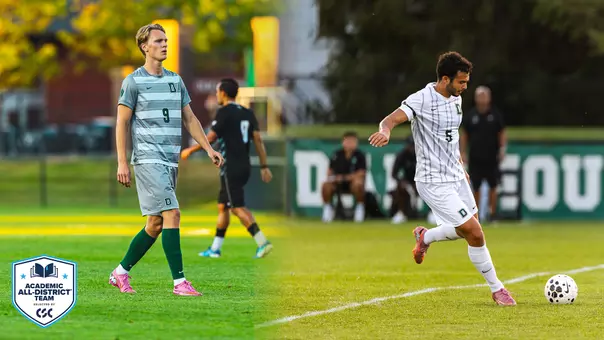
HANOVER, N.H. – Tyler Dowse '19 experienced a warm welcome to Dartmouth, clinching the Ivy League Championship at home his first year and celebrating on the field with a packed crowd.
Memories like these Dowse still looks back on fondly, even six years removed and working full-time at DraftKings. The experiences and relationships are what he remembers most about his time at Dartmouth.
Check in with Dowse as he reflects on how Dartmouth prepared him for a full-time role and what he hopes others take away from their time in Hanover.
Q: Talk about your experience as a student-athlete at Dartmouth.
A: …It was such a big part of my Dartmouth experience like a lot of other Dartmouth students. It takes so much of your time so to have a really good experience that you look back on very fondly of is going to define how you think of Dartmouth as a whole. We were fortunate enough to have a really good program and have some really good guys on the team and we were relatively successful which was nice and that makes everything a lot easier.
I know that when I think back about Dartmouth on the whole, 'why do you love Dartmouth, why was the experience so great and why would you recommend it to people,' the first memory is all the stuff with the soccer guys because that was so much of what you did.
Q: While you were a member of the soccer program, what did you learn and how did you grow as a student, a person, and an athlete?
A: As a person, and particularly as someone who had grown up in the same place my whole life and not traveled a lot and done a lot of things, I learned a lot about how many different people there are in the world. At any given time, our team probably had like, eight, nine, ten different countries represented from a couple different continents. I just got to meet a lot of very different people, and that was kind of the first time in my life, I got to do that. Because you're sharing the sport, and same goals, and driving towards the same mission, you build a bond with those people. To have that experience, where you're meeting all these different people, you're forming these really great relationships, and it's kind of stretching how you see the world was really cool.
As an athlete, obviously, you've got to learn how to go to the next level and be better. And that's hard for a lot of people when they go to school. I think everyone who plays college ball is the best player on their high school team, they're the best player on their clubs, then all of a sudden, you start having to play for playing time, and you're not a starter, and you don't get to travel. There's a lot of maturing you have to do, I think pretty quickly at 19 years old for the first time. So, there's a lot of growth there.
Now, one of the best things I ever got out of [soccer] was learning how to manage your time and your relationships. Like I was saying you spend so much of your time at practice, in the locker room, traveling, at team meals, watching film. It's kind of the first time in your life, you have to prioritize things. So, you know, you want to be a really, really good player, and you want to have good friends, you're probably not going to sleep a lot… So, then you think about when you graduate and you go get a job and start moving around, having kids or whatever, you're kind of doing the same thing. And so, it prepares you for that in a lot of ways.
Q: What is your favorite memory as a member of the men's soccer program?
A: I hate just picking one, because there's so many, but I do think my freshman year when we beat Brown at home to clinch the Ivy Championship was pretty cool… A totally packed house. We scored late. I think one of the seniors scored the winning goal. That was kind of the first time I really felt so strongly that sense of like Dartmouth community and people who I had never met running on the field hugging people, picking everyone up. I think that was like a really cool moment and to be a freshman at that time, I've been on campus for nine weeks, it was great to see how that community came together around that moment and to get to be a part of that I think was really cool and set the stage for a pretty cool three years after that.
Q: Now that you are no longer at Dartmouth, what are you up to now? What are you doing?
A: I do product analytics at a sports betting company called DraftKings now, which was 1,000% not on my bingo card. When I graduated, I thought I wanted to go into some kind of finance or banking or consulting, like a lot of Dartmouth guys do. I did a bunch of interviews, realized that wasn't really for me. So, I pivoted around, thought about what I wanted to do, where I wanted to live and DraftKings came up on that list.
So, I applied for an analytics role that I was completely unqualified for and somehow got hired. I remember on my first day, my manager asked me how much code I had written and like how comfortable I was writing code. I basically told him zero seconds. And it's worked out I'm at the office right now, what, six years later?
Our product analytics is basically around how do people use our sports book app? What pages do they go to, features they use? Where are their points of friction? How can we make navigation, or merchandising smoother, cleaner, things like that. So, we need to crunch the numbers on that, tell stories and go back to our product team and tell them how to make the app better. Which is, is pretty fun. Still doing it six years later.
Q: How did Dartmouth as an institution and the soccer program prepare you for your job?
A: I think the best thing Dartmouth did for me as a student…was to just teach me how to think critically about stuff, even if I wasn't familiar with it. Think critically and try to just ask a lot of questions and learn… I think Dartmouth does a really good job, probably by design with the liberal arts stuff, to just teach you how to look for the right thing at the right moment. Be cautiously critical of things and just be willing to be uncomfortable in situations where you don't know everything.
…Getting into analytics that I had no background in, I had to go in the room and be like, 'I don't know what's going on right now. Like I need someone to help me, this sounds like it's important. Can you explain that to me a little bit more? How can I practice that?' So, I think without whatever it is in the Dartmouth curriculum that teaches you that I probably wouldn't have made it out very well. So thankfully, that that was something I think I picked up in school.
Q: Would you say the ability to think critically is one of the biggest similarities between being a student-athlete and being in the workforce?
A: I think so. I mean, I can tell you for sure, what I learned in [class], I've never used that. Reading Marx and sociological classics, or doing some economics supply and demand, I couldn't even tell you what I've learned, because I don't ever use it. But I know that through the exercises, the tests, the learning and there was something in all of that, that taught me how to just ask the right questions, and to be really inquisitive and thoughtful. And I use that every day. That's what analytics is… It's all the stuff that's not captured in those two degrees that came along with it that I'm actually using in my job.
Q: If you could take another similarity between playing collegiate athletics and your role at a large company, what would it be?
A: Honestly, I'll say, one of the biggest similarities, particularly for DraftKings, which is, yes, somehow a big company, but we don't always act like it. We're still very chaotic, we change our minds a lot. We try stuff, we break things, we go back to the drawing board. That's a soccer game. That's a soccer season, right? Like, sometimes stuff doesn't go your way. Sometimes you have to change your plan on the fly, sometimes, what you thought was going to be a really good idea just totally backfires and you've got to come up with something new. You have to react quickly. And I think that's like a lot of what I got from playing on the team.
I'll also say on the people side. Now, I'm not just doing my own work and managing people. If I didn't have the experience at Dartmouth, playing soccer with a lot of people who are very different from me, I don't think I'd be very good at managing people. There's an aspect of understanding that everyone is different, everyone behaves differently, everyone needs different things to succeed. And so, if you try to talk to one person this way, and that's not their style, it's not going to work… And you always have to know how to manage those different personalities and inspire people in different ways. And having had such a diverse personal experience on the team, has definitely helped me understand how to do that in the workplace.
Q: If you could go back and tell yourself anything, whether starting college or finishing college, what would you say?
A: Take a fifth year or get another degree, don't leave. It's great. Hanover is the best place in the world. I love going back. I love going back with my teammates, I love spending time there in the winter and summer in the fall, it doesn't really matter. I think the longer I've been away from it, the more I realize how incredible it is. And I just think of the people that I'm still in touch with and that I care about the most and they're all people from Dartmouth. And it's those relationships and, and the place itself and the experiences we have there that make me feel so fondly. So, I would you know, get a master's or you know, go to business school there or whatever it is, just spend more time in Hanover, meet more people, get more relationships because it's really hard to ever look back on any of that stuff and not be super happy about it.
Q: Is there anything else you'd like to add?
A: I guess the only other thing I'd say just on the soccer experience in particular is it's funny when people ask me what I remember most about it, because I don't remember like who we played, at what time, I don't remember the score… But like the specifics of the soccer itself, I never really remember that stuff.
What I really remember is like the people, the experiences, the locker rooms, the bus rides, the pre games and spending time with each other after practice, getting meals together, hanging out in the library. Yes, it's about the soccer, that's why you're on the team. It's obviously a huge piece of it. But the further I get out from it, the more I just remember the experiences and the people. And that's great, because that's the stuff you can take with you after college. Right? You may stop playing and you may not be involved in the game anymore. But the friends you made and the people you connected with are the things that you don't ever have to give away after you graduate. I think that's why I still just feel so passionately about the program because, yeah, I'm not still playing soccer. Yeah, I'm not still wearing the jersey. But all the people I've met along the way I'm still super close with and I think that's awesome.